
SMED workshop lens
How is SMED applied in the Lean Factory Game?
In the LeanActivity Factory Game, SMED is not explained as a theory block. Participants experience the pressure of changeovers directly, map the setup sequence in detail, and then redesign the process step by step.
The optimization of changeover processes is a core step toward lean and efficient production. SMED helps teams make setup work visible, separate what must happen during the stop from what can be prepared beforehand, and reduce lost time between product changes.
The LeanActivity Factory Game includes a dedicated changeover sequence and a full SMED workshop round. Whenever production switches from one product to another, materials, tools and machine settings have to change. That is where participants encounter waiting time, unclear handovers and activities that look normal at first, but become obvious improvement levers once they are mapped.
While watching the video
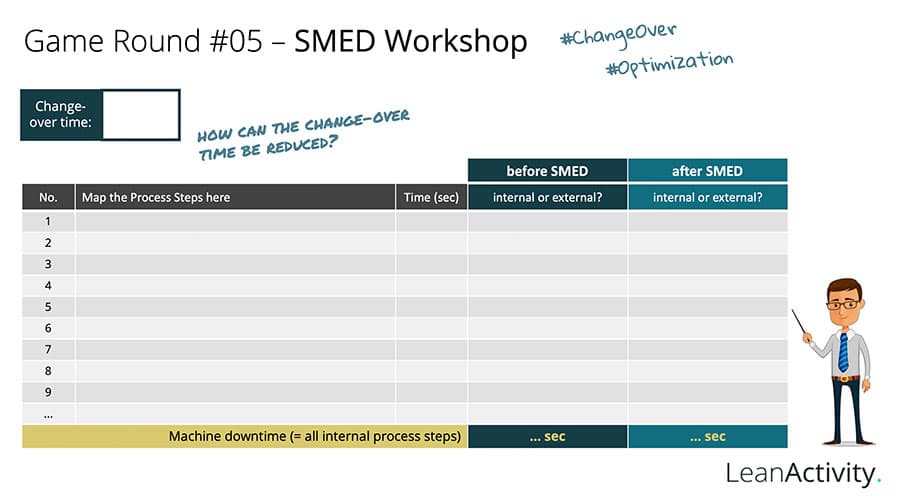
What to capture on the worksheet
- Each process step in the order it happens
- Time spans, waiting phases and walking distances
- Who performs the activity and when the machine is idle
- Which steps could be prepared before the actual changeover starts
SMED thinking
The questions the team should ask
- What is truly internal and must happen during machine downtime?
- What can be moved outside the stop and prepared in advance?
- Which search, transport or adjustment steps can be simplified?
- How can the station be redesigned so the next setup becomes easier?
Printable support
Download the process mapping sheet before you start
Print the PDF, watch the walkthrough once without interruption, then run it again and document the full setup sequence. This makes the later SMED discussion much more concrete and gives the team a shared basis for the redesign.
Download the PDF and run the SMED round yourself
A similar activity is also part of the full LeanActivity training flow. The participants typically watch the changeover repeatedly until the sequence is fully mapped and the time losses are understood well enough to challenge them.
After that, the workshop moves from observation to redesign. Participants apply SMED principles, tweak the station and rethink preparation work to reduce or even eliminate parts of the changeover. The strength of the game is that the improvement ideas do not stay abstract. Teams can test them immediately in the simulation and see whether the setup actually gets shorter and smoother.
This keeps the SMED chapter consistent with the broader Factory Game: first make the current state visible, then redesign it with concrete Lean principles, and finally validate the effect in the next round. That makes the exercise useful both for internal training and for external Lean workshops with customers or teams in production.
Why this stays coherent
What participants should take away from this round
SMED starts with careful observation, not with quick solutions.
Separating internal and external activities creates immediate leverage.
Layout, preparation and standardization work together in setup reduction.