On this page
Download the free gemba walk checklist
This gemba walk checklist helps leaders go to where the work happens, observe and ask the right questions. It contains 30 gemba walk questions in six areas, columns for OK, problem and your observation, and a second page to agree actions and follow them up. Free to print and use, no sign-up.
What a gemba walk is for
Gemba is Japanese for “the real place”: the shopfloor, the warehouse or the office where value is created. On a gemba walk, a leader goes there to see the process with their own eyes, talk to the people who run it and understand problems before deciding anything. It is a core routine of Lean management and part of leader standard work. For the background of the term, see gemba in our Lean glossary.
A gemba walk is not an inspection tour. Its purpose is to:
- see how the work really runs, compared with the standard;
- find waste and problems while they are still small;
- show respect by listening to the people closest to the work;
- follow up on earlier problems and ideas.
Plan your gemba walk
- Pick one focusSafety this week, flow next week. A focus keeps the walk short and the observations sharp.
- Choose the routeFollow the product or the information from start to end, not the corridor.
- Tell the team you are comingA gemba walk is not a surprise audit. People should know its purpose.
- Take the checklist and the last action listStart by checking what happened to the problems from the last walk.
The 30 gemba walk questions
These are the questions of the checklist, grouped into six areas. Use five to ten of them per walk, depending on your focus.
Safety
- 1Are walkways, emergency exits and safety equipment free and marked?
- 2Is the required protective equipment available and worn?
- 3Are there unsafe conditions or near misses nobody has reported?
- 4Do people lift, reach or twist in ways that strain them?
- 5Does everyone know whom to tell when something is unsafe?
Quality
- 6Is the current quality status visible at the workplace?
- 7What happens when a defect is found, and who is informed?
- 8Are inspection points and quality standards clear to everyone?
- 9Are there signs of rework, scrap or sorting?
- 10Is error proofing (Poka-Yoke) in place at critical steps?
Flow & waste
- 11Where does material wait, and why?
- 12How far do people and parts travel between steps?
- 13Is there more work in progress than the defined limit?
- 14Do people search for tools, parts or information?
- 15Does the work keep pace with customer demand (takt)?
Standards & visual management
- 16Is standard work available and followed at this station?
- 17Can you see at a glance whether the area is on plan?
- 18Are the 5S standards maintained?
- 19Are abnormalities visible without asking anyone?
- 20Is the team board up to date with today's figures?
People & improvement
- 21What problem got in the way of your work today?
- 22Which improvement idea do you have for this process?
- 23What happened to the last idea you suggested?
- 24Does the team have the time and support to solve problems?
- 25Is the training for this workstation documented and current?
Leader follow-up
- 26Which problems from the last walk are solved?
- 27Which problems need help from another department?
- 28Who owns each action, and by when?
- 29What did I learn here that I did not know before?
- 30When will I come back to check the result?
On the walk: do’s and don’ts
| Do | Don’t |
|---|---|
| Watch the process quietly for a few minutes first | Arrive with solutions |
| Ask open questions: what, where, why, how | Ask who made the mistake |
| Write down what you see, with facts and times | Rely on your memory after the walk |
| Thank people for showing problems | Punish bad news |
| Agree on next steps with the team | Promise what you cannot follow up |
Follow-up: close the loop
Page 2 of the checklist turns observations into actions: what you saw, the agreed action, the owner and the due date. Share the list with the team, track it on their board and start your next walk by checking it. A problem from the last walk that is still open is the most important question of the next one.
Improvement ideas that come up on the walk deserve a home as well: a simple idea management process makes sure they are decided and implemented.
Build the routine
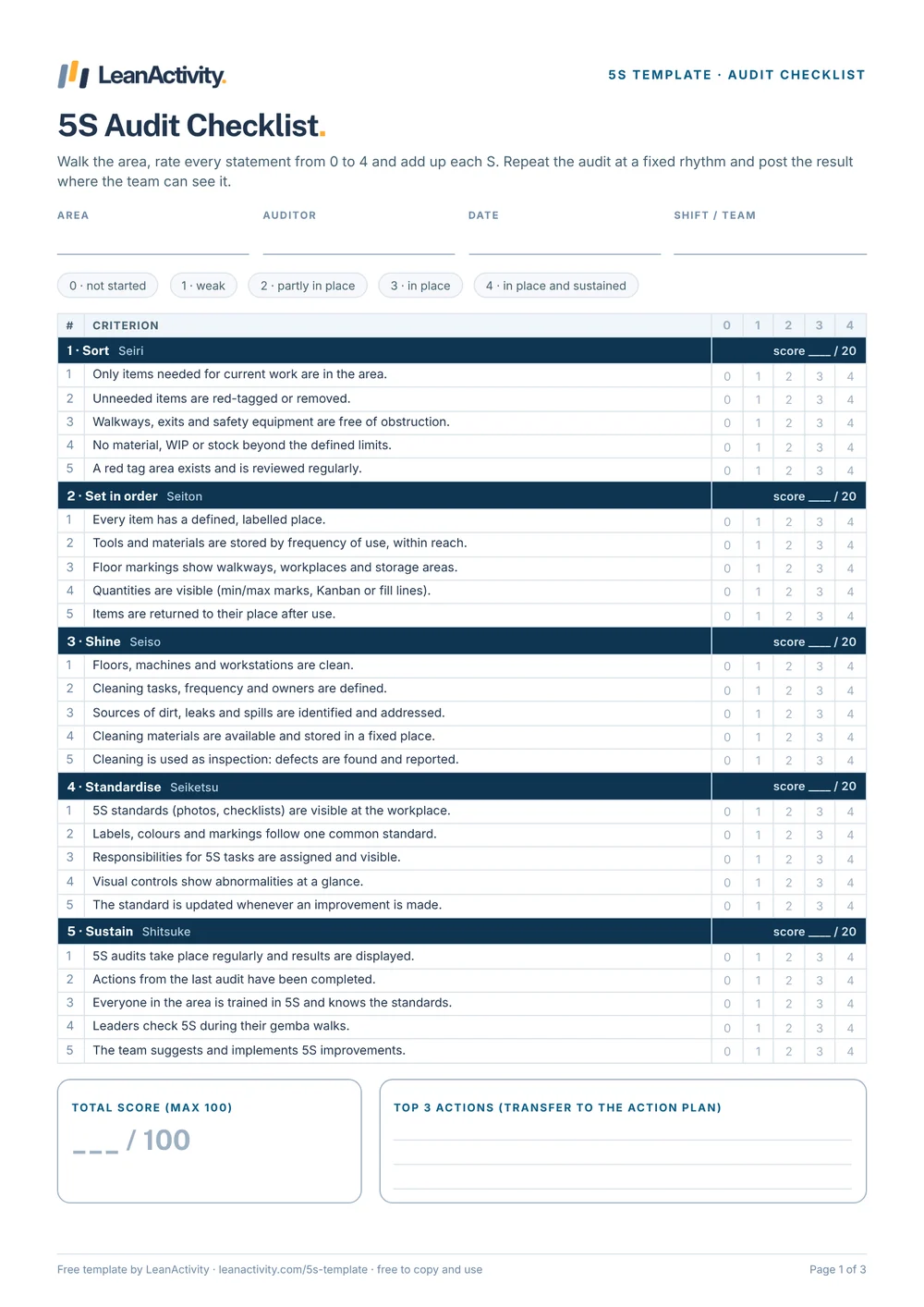
The value of gemba walks comes from repetition. Put them into leader standard work with a fixed rhythm, rotate the focus, and combine them with other routines such as a regular 5S audit. To give leaders and teams a shared picture of what waste and flow look like, many companies start with a hands-on Lean training before the first walks.
Frequently asked questions.
What is a gemba walk checklist?
A gemba walk checklist is a short list of questions a leader takes along when visiting the place where the work happens. It keeps the walk focused on observing and asking, and it records what was seen so that actions can be followed up.
What questions should you ask on a gemba walk?
Open questions about the process and its problems: what slowed the work down today, where material waits, what happens when a defect is found, which idea the team has and what happened to the last one. Avoid questions that judge people; the walk is about the process.
How long should a gemba walk take?
Many walks take 20 to 45 minutes. A short, regular walk with one focus is more useful than a long tour once a quarter. Plan time to observe quietly before you ask anything.
How often should leaders do gemba walks?
As part of leader standard work, team leaders often walk daily, area managers weekly and plant managers at a fixed rhythm per month. The rhythm matters more than the frequency: people should know when the leader comes and see that problems are followed up.
Do I need to ask all 30 questions?
No. Choose a focus for each walk, for example safety or flow, and use five to ten questions. Over several walks you cover the whole list.