On this page
What training on the shopfloor must achieve
Manufacturing training has one job: to make sure that every person on the shopfloor can do their work safely, to standard and with the confidence to improve it. A course catalogue does not achieve that on its own. A programme does – one that combines several formats, each doing what it does best, and a simple way to see who can do what.
Good production training therefore answers three questions for every employee:
- Can they do it safely? They know the hazards of their station, the safety rules and what to do when something goes wrong.
- Can they do it to standard? They follow the agreed method, reach the required quality and keep the cycle time without shortcuts.
- Can they improve it? They see waste, raise problems and contribute ideas instead of working around issues.
The seven formats in this guide cover all three questions. None of them is new. The difference between a programme that builds skilled teams and one that produces training records lies in how deliberately you combine them.
7 manufacturing training formats at a glance
| Format | What it builds | Best for | Watch out for |
|---|---|---|---|
| 1. Structured onboarding | Orientation, safety basics, a sense of belonging | Every new starter, including agency staff | Turning day one into a slide marathon |
| 2. On-the-job instruction | The skill to do one task to standard | Every task at every station | Experienced operators teaching “their” way instead of the standard |
| 3. Skills matrix | An overview of who can do what, and where the gaps are | Team leaders planning shifts and training | A chart on the wall that nobody updates |
| 4. E-learning micro-modules | Knowledge: product variants, defects, machine basics | Many people, shift workers, refreshers | Using it to teach hands-on skills |
| 5. Safety and quality training | Safe behaviour and reliable defect recognition | Everyone, before working alone | Ticking boxes for the next audit |
| 6. Lean simulations | Understanding of flow, waste and improvement | Mixed teams, new and experienced | A fun day without follow-up |
| 7. Coaching and train-the-trainer | Internal trainers and leaders who coach | Team leaders, experienced operators | No time released for training |
Formats 1, 2 and 5 are not optional: every new employee goes through them. Formats 3 and 7 make the programme scale beyond a handful of people. Formats 4 and 6 make it efficient and give people the bigger picture of the process they are part of.
Onboarding and on-the-job instruction
1. Structured onboarding
The first days decide whether a new starter feels prepared or lost. A structured onboarding plan for production covers:
- A named buddy for everyday questions and a named trainer for the work itself – they can be different people.
- A walk along the value stream: where material comes from, what the line makes and who the customer is.
- The safety induction: protective equipment, emergency routes, the hazards of the area and how to stop the line.
- The daily routine: shift handover, the team meeting at the board, breaks, who to ask.
- A written plan for the first weeks, so the new starter knows which station they will learn and when.
2. On-the-job instruction with standard work
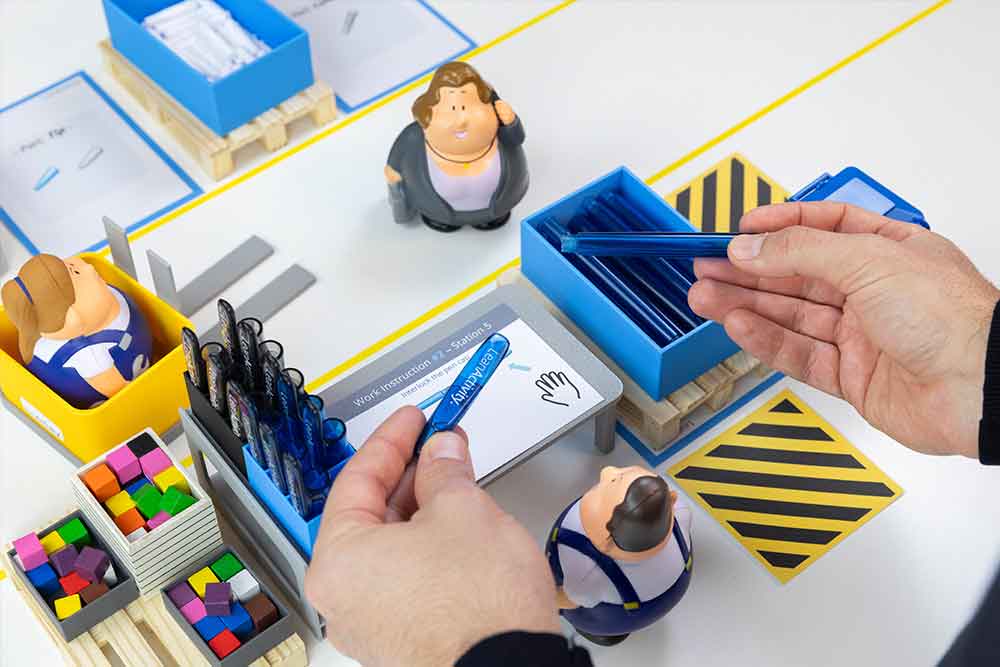
Most production skills are learned at the station. The question is whether they are learned by chance – “sitting by Nellie”, as the old British phrase goes – or by method. The method that has stood the test of time is Job Instruction from Training Within Industry (TWI), developed in the United States during the Second World War and still used by Lean organisations to teach work at the station.
It starts with a job breakdown. The trainer splits the task into important steps, adds the key points for each step (whatever makes or breaks safety, quality and ease of work) and the reason for each key point. The breakdown is taken from the standard work of the station, so every trainer teaches the same method. Then the trainer follows four steps:
- Prepare the workerPut the person at ease, explain the task and why it matters, and find out what they already know.
- Present the operationShow the task one important step at a time, then again with the key points, then a third time with the reasons.
- Try out performanceThe learner does the task while explaining the steps, key points and reasons; the trainer corrects mistakes immediately.
- Follow upThe learner works independently and knows who to ask; the trainer checks back often at first, then less frequently.
TWI sums the approach up in one rule: if the worker hasn’t learned, the instructor hasn’t taught. It moves the responsibility from the learner to the training method, which is exactly where it belongs.
The skills matrix: who can do what
The third format holds the others together. A skills matrix – also called a training matrix or qualification matrix – lists the people of a team in rows and the tasks or stations in columns. Each cell shows the level a person has reached. It is the planning tool for both training and shifts: the team leader sees at a glance who can cover which station and where the risks are.
| Level | Meaning | Evidence |
|---|---|---|
| 0 | Not trained | – |
| 1 | In training, works only under supervision | Job instruction has started |
| 2 | Works independently to standard, quality and cycle time | Observation against the standard work |
| 3 | Can train others and help improve the standard | Has trained a colleague with the job instruction method |
Three rules keep the matrix useful:
- Cover every critical task several times. Set a minimum number of qualified people per station, for example three, so that holidays and sickness do not stop the line.
- Base levels on observation, not attendance. A training record says someone attended. Level 2 means somebody watched them work to standard.
- Review it in the team meeting. Once a month, look at the gaps, plan the next training and update the cells. A matrix that hangs on the wall unchanged for a year is decoration.
E-learning micro-modules, safety and quality training
4. E-learning micro-modules
E-learning is good at knowledge and weak at skills. Short modules of a few minutes work well for things people need to know and look up: product variants, the defect catalogue, the meaning of signals on a machine, the steps of a changeover or the rules of the plant. Shift workers can complete them on a tablet at the line or in a quiet slot of the shift.
- One topic per module, ending with a short check of understanding.
- Real photos and videos from your own line rather than generic stock material.
- Linked to the skills matrix: the module is the prerequisite, the observation at the station is the proof.
5. Safety and quality training
Safety training is the part of manufacturing training that is required by law, so it easily becomes a ritual. Keep it practical: walk the area, show the real hazard, practise the real response. Lockout procedures, the handling of hazardous substances and the use of protective equipment are best trained at the machine, not in a meeting room. Your local regulations define the minimum content and how often it must be refreshed.
Quality training follows the same logic. Operators learn to recognise defects with real parts and limit samples, carry out the checks defined for their station and react correctly when something is wrong: stop, mark, inform. Show them the error-proofing devices on their station and explain what each one prevents – poka-yoke only works when people understand why it is there and do not bypass it.
Lean simulations, coaching and train-the-trainer
6. Lean simulations
Formats 1 to 5 teach people their job. A Lean simulation shows them how their job fits into the whole process. In a simulation game, a team runs a small factory, experiences the effect of waste, long changeovers and inventory, and then improves it round by round with 5S, standard work, SMED, Kanban and one-piece flow. Because every change shows up in the numbers, participants understand why the standards on their own line look the way they do.
Schedule the simulation within the first two months for new starters and run it with mixed groups: new operators, experienced colleagues, team leaders, logistics and quality. Formats, agendas and costs are covered in detail in our guide to Lean training, so just one recommendation here: always end the session with one improvement idea per participant for the real line.
7. Coaching and train-the-trainer
The programme only scales when your own people deliver it. Train-the-trainer means that experienced operators and team leaders learn to instruct with the job instruction method, to run a simulation and to coach. Give them three things:
- Time: training hours planned in the shift schedule, not squeezed in between tasks.
- A method: job breakdowns, the four instruction steps and a simple observation checklist.
- Feedback: an experienced coach watches their first sessions and gives concrete feedback.
For internal trainers who will facilitate simulations, our tips for running a Lean simulation cover the setup, the timing and the debrief.

Combine the formats: a 90-day training programme
The formats pay off when you combine them into one plan per new employee. The structure below suits most assembly and machining environments; adapt the stations and the pace to your process.
| Period | Formats | Goal at the end |
|---|---|---|
| Week 1 | Structured onboarding, safety induction, first e-learning modules, start of job instruction at station 1 | Knows the area, the rules and the team; works at station 1 under supervision (level 1) |
| Weeks 2–4 | Job instruction at station 1, quality training with real parts, daily feedback from the trainer | Works independently at station 1 (level 2) |
| Weeks 5–8 | Lean simulation with a mixed group, job instruction at station 2, first improvement idea | Understands flow and waste; level 1 to 2 at station 2; one idea submitted |
| Weeks 9–12 | Job instruction at a further station or support task, safety refresher at the machine, skills matrix review | Level 2 at two or more stations; development plan agreed |
| Day 90 | Review conversation with the team leader | Next steps agreed: further stations, level 3 or train-the-trainer |
Two details make the plan work. First, every period ends with an observation at the station, not a test on paper. Second, the team leader owns the plan, while HR or L&D provide the structure and the materials. If you also want established teams to learn structured problem solving, build a continuous improvement programme on top.
How to measure skills and training results
Measure the programme on three levels: the skills of individuals, the capability of the team and the results of the process.
- Individual skills: the level per task in the skills matrix, confirmed by observation against the standard work.
- Time to independence: how many weeks a new starter needs to reach level 2 at the first station. Track it per group of new starters; if it falls, your training is getting better.
- Team capability: the number of qualified people per critical station and the gaps closed each month.
- Process results: first-pass yield, scrap, safety incidents and near misses in the areas where new people work. Compare groups over time rather than individuals.
- Engagement: improvement ideas submitted and implemented by people in their first months.
Where LeanActivity fits into manufacturing training
LeanActivity provides the simulation part of the programme (format 6) and supports your internal trainers (format 7):
- The tabletop Factory Game is a physical factory kit for 6 to 16 players. A session takes about 4 hours, setup about 15 minutes, and video-guided facilitation helps internal trainers run it. You buy the kit once and can use it for every new group of starters.
- The browser-based Online Game is a 3D factory for 2 to 20 players in teams of 5 – useful when shifts or sites cannot meet in one room.
- On-Site Training brings two LeanActivity coaches to your plant for an 8-hour workshop, with a game kit and a training roadmap.
Whichever you choose, connect it to the rest of the programme: schedule it in weeks 5 to 8 for new starters, let team leaders moderate once they have taken part, and record the ideas from every session in your improvement routine.
Frequently asked questions.
What is manufacturing training?
Manufacturing training is the structured development of production employees so that they can work safely, to standard and improve their processes. It combines formats such as structured onboarding, on-the-job instruction, a skills matrix, safety and quality training, e-learning, Lean simulations and coaching.
What should a manufacturing training programme include?
At a minimum: structured onboarding, safety and quality training, and on-the-job instruction based on standard work. A skills matrix makes progress visible, short e-learning modules cover knowledge, a Lean simulation shows the whole process, and train-the-trainer lets your own people deliver the programme.
How long does it take to train a new production employee?
It depends on the complexity of the tasks and the number of stations a person needs to cover. A 90-day structure works well: onboarding in the first week, independent work at the first station within the first few weeks, then further stations. Track the time to independent work for each group of new starters to see whether your training improves.
What is a skills matrix in manufacturing?
A skills matrix lists team members against tasks or stations and shows the level each person has reached, for example from not trained to able to train others. Team leaders use it to plan shifts, spot gaps before they become a problem and decide who learns which station next.
What is TWI Job Instruction?
Job Instruction is one of the Training Within Industry programmes developed in the United States during the Second World War. The trainer breaks a task down into important steps, key points and reasons, then teaches it in four steps: prepare the worker, present the operation, try out performance and follow up.
How do you measure the effectiveness of manufacturing training?
Look at observed skill levels in the skills matrix, the time new starters need to work independently, the number of qualified people per critical station and process results such as first-pass yield, scrap and safety incidents. Compare groups of new starters over time rather than judging individuals.


