On this page
What continuous improvement training should change
Continuous improvement training fails when it is treated as a course. People attend, learn PDCA, receive a certificate – and the next morning the same problems are worked around in the same way. It succeeds when it changes daily work: teams that see problems, solve them with a method and make small improvements every week, without waiting for a project.
That needs a programme, not an event. The five steps below build on each other, and each one ends with something applied in the real process:
- See the wasteExperience the difference between a wasteful and a Lean process, ideally in a Lean simulation, and learn the eight wastes.
- Solve problems with a methodLearn PDCA, the 5 Whys and the A3 report on real problems from the team’s own area.
- Make Kaizen part of the daily routineBuild a short daily meeting at a board where small improvements are raised, decided and implemented.
- Run a first improvement projectApply everything in a focused Kaizen event on one process with a measurable target.
- Sustain the gainsSecure the results with standard work, visual management, idea management and coaching by leaders.
Leave a few weeks between the steps, so that each one is applied before the next begins. Around three months is a realistic timeframe for a first pilot team.
Who should attend continuous improvement training
Continuous improvement is everyone’s job, but not everyone needs the same depth. Train intact teams together – the people who share a process – and include their leaders. Otherwise trained individuals return to a team that does not know the method, and the new habits fade.
| Group | Role in continuous improvement | Steps and depth |
|---|---|---|
| Operators and office staff | Spot problems, suggest and implement small improvements | Steps 1, 2 (PDCA and 5 Whys) and 3 |
| Team leaders and supervisors | Lead the daily routine, coach problem solving | All five steps, plus coaching practice |
| Managers | Set direction, remove obstacles, go to the gemba | Steps 1, 2 (A3 basics) and 5, plus regular gemba walks |
| Quality, maintenance, planning, IT | Solve problems across functions, join improvement projects | Steps 1, 2 and 4 |
| CI coordinators and Lean specialists | Run the programme, facilitate events, train trainers | All steps in depth, plus facilitation |
Start with one pilot area whose manager is willing to take part personally. A visible success there is the best argument for the next area.
Step 1: the mindset and the wastes
Improvement starts with seeing. Most employees know the problems in their process, but they have learned to live with them: the search for a tool, the batch that waits, the form that comes back incomplete. Step 1 turns that background noise into waste with a name.
The most effective way to do this is a Lean simulation. A team runs a small factory under chaotic conditions, measures the result, then improves it round by round and watches the numbers change. In a few hours participants experience what slides cannot convey: waste is a property of the system, not of the people in it, and small changes add up.
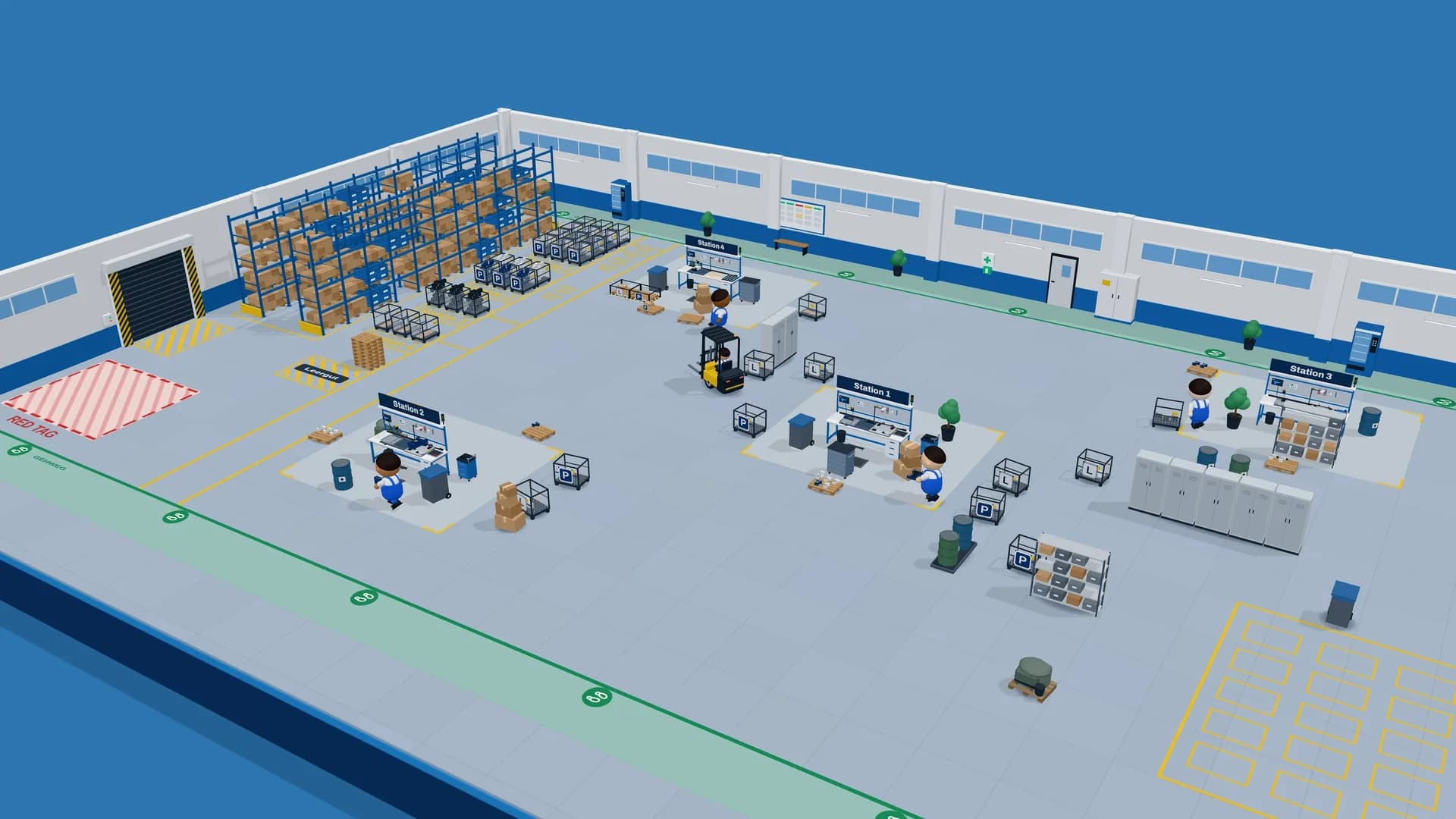
Then translate the experience into the eight wastes, remembered as TIMWOODS: transport, inventory, motion, waiting, overproduction, overprocessing, defects and unused skills. End the step with a short waste walk in the team’s own area, where everyone notes three examples. Those notes become the material for step 2.
Teams spread over several sites can run this step remotely. The LeanActivity Online Game is a 3D factory in the browser, and a moderator leads up to 20 players through it, for example in an MS Teams call.
Step 2: problem solving with PDCA, 5 Whys and A3
Teams that see more problems need a way to solve them, or frustration grows. Step 2 teaches one simple method and practises it on real problems from the waste walk.
PDCA as the backbone
The PDCA cycle – Plan, Do, Check, Act – sits behind every improvement: understand the problem and plan a countermeasure, try it, check the result against the target, then standardise it or start another cycle. Teach it as a way of thinking, not as a form to fill in.
The 5 Whys
The 5 Whys help a team move from the symptom to a cause it can fix. A short example from a packing line:
- Boxes left the line without a label. Why? The label printer ran out of labels during the shift.
- Why? Nobody noticed that the roll was nearly empty.
- Why? The roll sits inside the printer housing and cannot be seen.
- Why? There is no signal for a low roll and no rule for when to change it.
- Countermeasure: a visible minimum mark on the roll and a roll check in the routine at the start of each shift.
Five is a guideline, not a rule. Stop when you reach a cause the team can act on, and check every answer at the gemba instead of guessing in a meeting room.
The A3 report
For larger problems, the A3 report tells the whole PDCA story on one sheet: background, current condition, target, root cause analysis, countermeasures, implementation plan and follow-up. Its value lies less in the format than in the conversation it creates between the problem owner and their coach.
Step 3: Kaizen in the daily routine
Most improvement happens in small steps that never become a project. Step 3 builds the routine that makes those steps happen every week:
- A short daily meeting at a board. The team looks at yesterday’s performance, today’s plan and open problems – standing, at the same time every day, in about fifteen minutes.
- A visible place for problems and ideas. One card each, with the problem, the proposed change, an owner and a date.
- A simple decision rule. The team decides and implements small changes within its own area straight away; anything that affects other teams goes to the team leader.
- Before-and-after records. A one-page Kaizen card with a photo before, a photo after and the benefit makes progress visible and spreads good ideas to other teams.
The team leader’s job is to protect the routine and to coach with three questions: What is the problem? What did you see? What will you try? Training for step 3 is therefore mainly training for team leaders, practised at the team’s real board rather than in a classroom.
Step 4: a first improvement project
Step 4 brings everything together in a focused project, usually a Kaizen event: a cross-functional team works for a few days on one process with a clear, measurable target – a long changeover, a bottleneck or an office process with too many handoffs. For the training programme, three choices matter most:
- Pick a problem that matters and can be solved. Big enough for management to notice, small enough to show results within the event.
- Mix the team. People from the process, one or two from neighbouring functions and a coach who knows the method.
- Measure before and after. Lead time, changeover time, defects or walking distance – whatever the target names – measured at the gemba, not estimated.
Scope, agenda and follow-up are covered step by step in our guide to planning and running a Kaizen event. Finish with a short presentation by the team to management. It is often the moment when participants realise what they are capable of.

Step 5: sustain the gains
Without step 5, improvements slowly erode and the programme becomes another initiative that came and went. Sustaining is a management routine rather than a training session, but people still need to learn it:
- Standard work. Every improvement ends with an updated standard work sheet, so the new method becomes the normal method and the starting point for the next improvement.
- Visual management. Targets, actual performance and deviations are visible at the workplace, so anyone can see within seconds whether the process is on track.
- Idea management. Ideas that go beyond one team need a clear path: submission, quick decision, implementation and recognition. Our article on managing employee ideas shows how to set it up.
- Coaching and gemba walks. Leaders go to the process regularly, ask about problems and countermeasures, and coach instead of solving. A gemba walk checklist helps them ask the right questions.
- Refreshers. New employees go through steps 1 and 2; experienced team members join as co-trainers.
A sample curriculum for the first pilot team
The curriculum below suits a pilot team of about 8 to 15 people over roughly three months. Adapt the durations to your shift model – the sequence matters more than the exact hours.
| Module | Content | Format | Duration |
|---|---|---|---|
| 1 Lean basics | Value, the eight wastes, flow and pull | Lean simulation plus a waste walk in the own area | Half-day |
| 2 Problem solving | PDCA, 5 Whys, defining a problem | Workshop on a real problem from the waste walk | 3–4 hours |
| 3 Daily Kaizen | Team board, daily meeting, Kaizen cards | Set-up at the team’s board, then two weeks of coaching | 2 hours plus coaching |
| 4 A3 thinking | The A3 report and the coaching conversation | Every team leader starts one A3 | 2–3 hours plus coaching |
| 5 Kaizen event | Applying the methods to one process | Cross-functional event at the gemba | 3–5 days |
| 6 Sustain | Standard work, visual management, idea process | Workshop plus first gemba walks with managers | 2–3 hours |
| 7 Review | Results, lessons learned, next area | Team presentation to management | 1–2 hours |
Running module 1 with a Lean game
Module 1 is where a game saves the most time. The LeanActivity Factory Game is a tabletop kit for 6 to 16 players that takes about 4 hours and covers standard work, 5S, SMED, logistics, Kanban and one-piece flow. The kit is bought once and can be used again for every new team, so the first module costs little when you roll the programme out to further areas. For distributed teams, the Online Game takes players through the Lean basics in a 3D factory in the browser.
KPIs to track the programme
Track the programme with two kinds of indicators: activity indicators that show whether the new habits are taking root, and result indicators that show whether the process improves. Activity comes first; results follow with a delay.
| KPI | Type | What it tells you |
|---|---|---|
| Share of the target group trained per step | Activity | Whether the programme reaches the people who need it |
| Improvements implemented per team and month | Activity | Whether daily Kaizen has become a habit – count implemented, not submitted |
| Time from idea to implementation | Activity | Whether decisions are fast enough to keep people motivated |
| A3 reports and Kaizen events completed | Activity | Whether structured problem solving is used beyond the training |
| Gemba walks held by managers | Activity | Whether leadership supports the routine |
| Safety, quality, delivery and cost in the pilot area | Result | Whether the process really improves, for example first-pass yield, lead time or OEE |
Review the KPIs monthly with the pilot team and its manager. If the activity indicators drop, look at the daily routine and the coaching before you add more training.
Frequently asked questions.
What is continuous improvement training?
Continuous improvement training teaches teams to see waste, solve problems with a structured method such as PDCA and make small improvements part of their daily work. Effective programmes combine short training modules with application in the real process and coaching by leaders.
How long does a continuous improvement training programme take?
A realistic first programme for a pilot team runs over about three months: modules of a few hours to a half-day, weeks of application in between and a Kaizen event of three to five days. The spacing matters, because each step should be applied in the real process before the next one begins.
What is the difference between Kaizen training and Lean training?
Lean training gives people the principles and tools of Lean, such as flow, pull, 5S or SMED. Kaizen or continuous improvement training focuses on the habit of improving: problem solving with PDCA, daily improvement routines and improvement projects. In practice the two belong together and can start with the same Lean simulation.
Who should take part in CI training?
Whole teams that share a process, together with their team leaders and managers. Team leaders need the most depth because they run the daily routine and coach problem solving, while managers need to learn how to support improvement with gemba walks and quick decisions.
Which problem-solving tools should a CI programme teach first?
Start with PDCA as the overall cycle and the 5 Whys for finding causes, applied to real problems from the team’s own area. Add the A3 report for team leaders and larger problems once the basics are used routinely.
How do you measure the success of a CI training programme?
Track activity indicators such as improvements implemented per team, the time from idea to implementation and gemba walks held by managers, and result indicators such as safety, quality, delivery and cost in the pilot area. Activity indicators react within weeks; results follow with a delay.


