On this page
What makes a Lean training work
Most people have sat through a Lean training with forty slides about the eight wastes, and most of them have forgotten it a week later. Lean is a practical discipline. People learn it the way they learn a sport: by doing it, getting feedback and doing it again.
The Lean trainings that change how teams work have three things in common:
- Experience first. Participants run a process, feel the waste and only then get the method that removes it.
- Numbers, not opinions. Every change is measured, so the team sees which improvement really helped.
- Transfer to real work. The training ends with concrete improvements at the participants’ own workplaces, not with a certificate.

Start with the goal, not with the format
Before you pick a format, write down what participants should be able to do after the training. For example:
- “Recognise the eight wastes in their own process.”
- “Explain flow, pull and takt time with an example from our plant.”
- “Run a 5S workshop in their own area.”
- “Bring one improvement idea and implement it within two weeks.”
Clear goals decide the depth of the training, the group and the format, and they make the result measurable.
Lean training formats compared
| Format | Best for | Strengths | Limits |
|---|---|---|---|
| Classroom with slides | Theory refreshers | Cheap, easy to schedule | Little lasting effect on behaviour |
| E-learning | Basics for many people | Self-paced, scalable | No teamwork, no real experience |
| Lean game on the table | Teams in one room | Hands-on, high energy, reusable kit | Participants must be in one place |
| Lean game online | Distributed teams, several sites | No travel, no setup, results recorded automatically | Needs a good moderator and stable connections |
| On-site training with coaches | Kick-offs, leadership teams | Experienced trainers, tailored to the plant | Higher cost per day |
| Kaizen workshop at the gemba | Applying Lean in the real process | Direct results in the process | Works best after a basic training |
Many companies combine formats: a Lean game for the basics and a common language, then Kaizen workshops in the real process. Read more about the games themselves in our Lean game guide.
A proven half-day Lean training agenda
This is the agenda of the LeanActivity Factory Game, a 4-hour Lean training for 6 to 16 players. It alternates short production rounds with improvement workshops, so every method solves a problem the team has just experienced:
| Block | Content | Time |
|---|---|---|
| Round 1 | Introduction to Lean manufacturing | 5 min |
| Round 2 | Standard work | 15 min |
| Round 3 | The 5S workshop | 30 min |
| Round 4 | The Lean layout workshop | 15 min |
| Round 5 | SMED changeover workshop | 30 min |
| Round 6 | Lean logistics and route train | 30 min |
| Round 7 | FIFO and supermarket | 30 min |
| Round 8 | Kanban and one-piece flow in action | 15 min |
| Round 9 | Design for manufacturing | 15 min |
| Round 10 | Final group discussion and commitment | 15 min |
Online Lean training: how to make it work
Online Lean training used to mean webinars. Browser-based Lean games change that: a moderator leads the team through the same rounds as on site, and every participant plays from their own computer.
Example: the LeanActivity Online Game
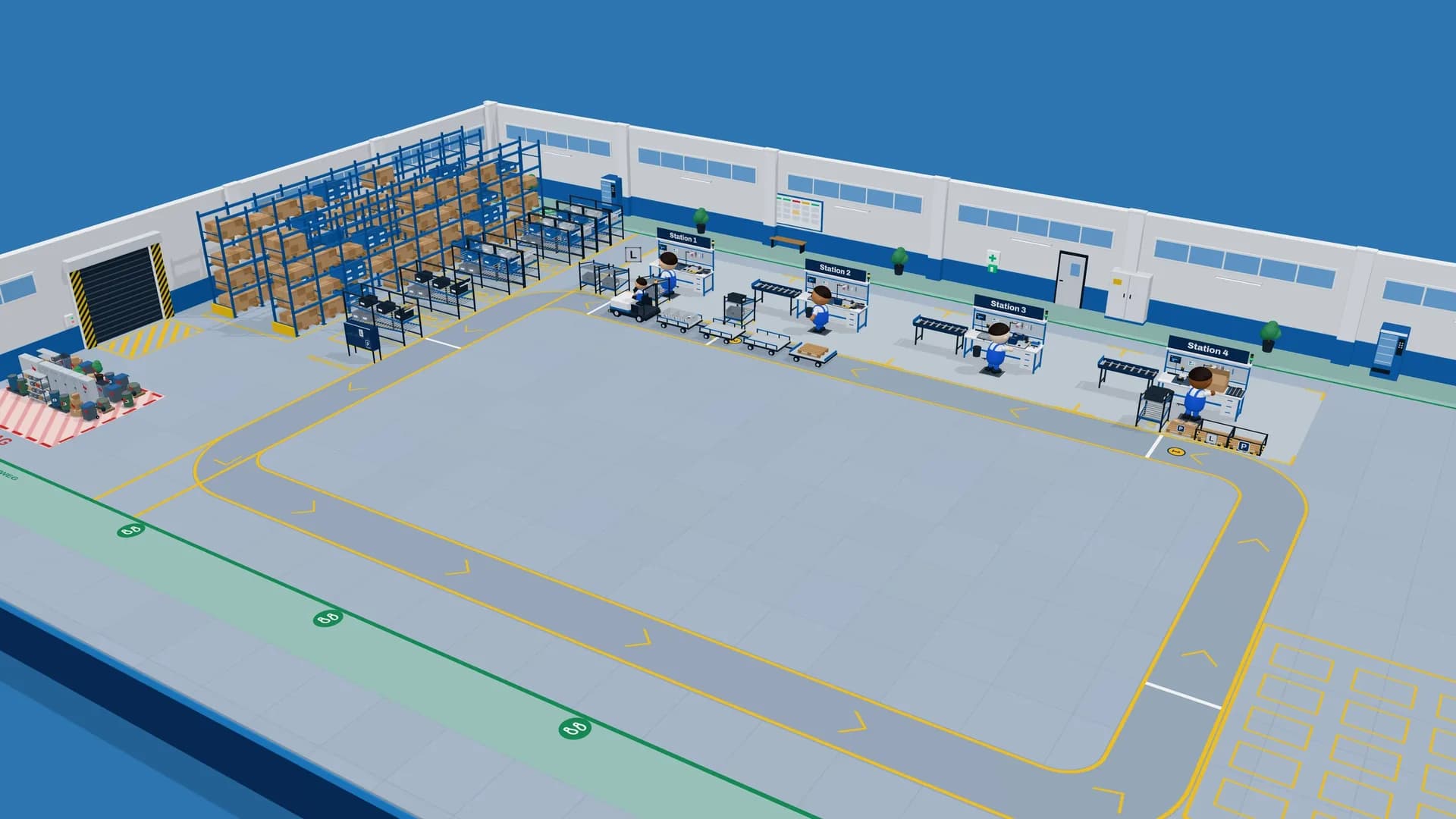
The LeanActivity Online Game is a 3D factory in the browser. A moderator, for example in an MS Teams call, leads 2 to 20 players in teams of 5 through 12 rounds: five shifts and seven improvement workshops, from the chaotic factory to the Lean factory. Bots fill the free seats when fewer people join, so the game also works with small groups.
Tips for online sessions
- Ask everyone to switch the camera on and use a headset. Lean is teamwork.
- Send the game link and test it with one participant before the session.
- Use breakout rooms for the team discussions in the workshop rounds.
- Share the results screen after every round and let the teams explain their numbers.
What does Lean training cost?
The cost of a Lean training depends less on the hours than on how often you run it. A one-off training with an external trainer is expensive per participant; a game you can run again and again gets cheaper with every session. As an example, these are the LeanActivity formats:
| Format | Price | Included |
|---|---|---|
| Online Game | €299–€499 per month | 5, 10 or 20 concurrent players; unlimited trainings and participants |
| Factory Game kit | €3,300 once | Physical kit for 6–16 players, unlimited game sessions |
| Office Game kit | €3,700 once | Lean office simulation for 6–12 participants |
| On-Site Training | €11,500 plus travel | A game kit, an 8-hour workshop with two coaches on site, a training roadmap |
Do not forget the largest cost: participants’ time. A format that people remember and apply is cheaper than a short one that changes nothing. See all details on the pricing page.
How to measure the result of a Lean training
A simple four-level view, based on the well-known Kirkpatrick model, keeps the evaluation honest:
- ReactionDid participants find the training useful and engaging? Ask right after the session.
- LearningCan they explain the methods? Compare the game results of the first and last round.
- BehaviourDo they apply Lean at work? Check the committed improvements after two to four weeks.
- ResultsDid the process improve? Look at lead time, quality or output in the areas that applied Lean.
After the training: make it stick
- Follow up on commitments. Review every participant’s improvement two weeks later, in the team meeting.
- Give ideas a home. Training sparks ideas. A simple idea management process makes sure they are decided and implemented.
- Build the routine. Daily meetings at a visual board and regular gemba walks turn the training into Lean management.
- Repeat. Run the game again with new teams and with leaders as moderators. Teaching Lean is one of the best ways to learn it.
Frequently asked questions.
What is Lean training?
Lean training teaches employees and leaders the principles and methods of Lean: how to recognise waste, create flow and pull, and improve processes continuously. The most effective Lean trainings are hands-on, for example with a Lean simulation game, and end with improvements in the participants’ own work.
How long should a Lean training be?
A solid introduction takes a half-day. The LeanActivity Factory Game, for example, is designed for about 4 hours with 6 to 16 players. Leadership teams sometimes prefer a condensed 60-minute version, while deeper programmes add Kaizen workshops in the real process over several weeks.
Can Lean training be done online?
Yes. With a browser-based Lean game, a moderator can lead a distributed team through the same rounds as on site, for example in an MS Teams call. The LeanActivity Online Game is built for 2 to 20 players in teams of 5, and bots fill free seats.
How much does Lean training cost?
It depends on the format. With LeanActivity, the physical Factory Game kit costs €3,300 once and can be used for unlimited sessions, the Online Game costs €299 to €499 per month depending on the number of concurrent players, and On-Site Training with two coaches costs €11,500 plus travel expenses.
Who should take part in a Lean training?
Ideally mixed groups: operators, team leaders, planners, quality and maintenance staff, and managers. When people from different functions play together, they see the whole process and learn a common Lean language.
How do you measure the success of a Lean training?
Measure on four levels: how participants rated the training, what they learned, which behaviours changed at work, and which results improved in the process. The first two can be measured right away, the last two after a few weeks.