On this page
What is a Kaizen event?
A Kaizen event is a focused improvement workshop in which a small cross-functional team improves one clearly defined process in a few days, usually three to five. The team leaves the meeting room, works at the gemba, where the work actually happens, tries changes straight away and hands over a new standard at the end. You will also hear it called a Kaizen workshop, a Kaizen blitz or a rapid improvement event. The method is the same.
It is the concentrated form of continuous improvement; the everyday habit of small improvements is explained in our glossary entry on Kaizen. An event fits when:
- a process has a visible, measurable problem: long changeovers, a bottleneck, piles of work in progress, recurring defects or slow approvals;
- the people in the process can find the solution;
- changes can be tried within days, without large investment.
It is the wrong tool for a new IT system or a problem that needs months of analysis. Those need a project, not a blitz.
The 7 steps at a glance
- Choose the process and scopeOne process, clear boundaries, one measurable target.
- Select the team and sponsorThe people who do the work, support functions and a sponsor.
- Prepare data and the current stateBaseline figures and logistics, two to four weeks ahead.
- Run the eventThree to five days, mostly at the gemba.
- Try changes with PDCASmall, fast experiments, measured against the baseline.
- Standardise and presentStandard work, every shift trained, a report-out.
- Follow up at 30, 60 and 90 daysClose the open actions and check that the result holds.
Step 1: Choose the process, the scope and a clear target
Most disappointing Kaizen events are lost before the first day, because the scope was too big. “Improve assembly” is a wish. “Halve the changeover time on press 4” is a scope a team can finish in a week.
Choose a process where an improvement matters to the customer or the business. A value stream map is the best source, because it shows where lead time, inventory and waiting build up. Good scopes for one event are, for example, the changeover on one machine, the material supply of one assembly line or the quotation process from enquiry to offer.
Then write a one-page event charter and have the sponsor sign it off:
- Problem: what hurts, in facts, not in opinions.
- Scope: first and last process step, area and shifts, plus what is out of scope.
- Target: one or two measurable goals with a baseline, such as changeover minutes, lead time or defects.
- Limits: the budget the team may spend without further approval, and constraints such as safety rules or customer approvals.
- Team, sponsor and dates, including the final report-out.
Step 2: Select a cross-functional team and a sponsor
Plan for around six to eight participants. The core of the team are people who do the work every day, from every shift involved. Add the functions you need to change things, such as maintenance, quality, logistics or, in an office, IT, and one outsider whose fresh eyes ask the questions insiders stopped asking.
One manager in the team is fine; a hierarchy is not. If the manager of the area is also the sponsor, they visit the team daily but do not sit in it, so that operators speak openly.
| Role | Who | Before | During | After |
|---|---|---|---|---|
| Sponsor | Manager who owns the area and the result | Approves the charter, releases the team | Opens day one, removes obstacles, decides at the report-out | Reviews the follow-up at 30, 60 and 90 days |
| Facilitator | Lean coach or CI manager, ideally from outside the area | Prepares data, agenda and materials | Guides the method, keeps time, keeps the team at the gemba | Coaches the team lead through the open actions |
| Team lead | Respected person from the area, often a supervisor | Helps to set the scope and choose the team | Leads discussions and decisions | Owns the action list and the new standard |
| Team members | Operators, support functions, one outsider | Clear their diaries for the whole event | Observe, measure, try changes | Work to the new standard, train colleagues |
The facilitator does not hand out solutions. The team that finds a solution owns it, and that ownership keeps the new process alive after the event.
Step 3: Prepare the data and the current state
Start two to four weeks ahead, so the team spends the event improving rather than searching for data. For the process in scope, collect output, lead time and work in progress; defects and scrap by type; cycle, changeover and waiting times; customer demand to calculate takt time; and photos or short videos of the current process, made with the consent of the people filmed.
Do not perfect the analysis: the team will observe the current state itself on day one. The data shows where to look and what to compare against. A short walk through the process by the facilitator and the team lead is the best check that the scope is right.
Pre-event checklist
- Charter signed by the sponsor
- Team members released for the whole event, with cover for their normal jobs
- Production planned around the event, with buffer stock if equipment will be moved
- Maintenance, electricians and IT booked for the days with changes
- Safety officer and employee representatives informed where workplaces or working times change
- The area told what the event is about and why
- A room near the gemba with flip charts, stopwatches, floor tape, red tags and cardboard for mock-ups
- Kick-off, daily check-ins and the report-out in the sponsor’s calendar
Step 4: Run the event with a day-by-day Kaizen event agenda
Five days is the classic format for a Kaizen blitz with physical changes; three days work well for a narrow scope or an office process. The rhythm is always the same: understand, improve, standardise, present.
| Day | Focus | Typical activities | Output |
|---|---|---|---|
| Day 1 | Kick-off and current state | Sponsor presents the charter; short hands-on Lean training; at the gemba: observe, time the steps, draw a spaghetti diagram | Shared view of target and current state |
| Day 2 | Analysis and ideas | List the wastes, find root causes with 5 Whys, sketch the future state, rank ideas by effect and effort | Future-state sketch, ranked ideas |
| Day 3 | Try changes | First PDCA cycles at the gemba: 5S, moved equipment, mock-ups, a new sequence; measure every trial | Tested changes with measured effects |
| Day 4 | Refine and standardise | Further cycles, standard work, visual management, training for all shifts | New standard in use on every shift |
| Day 5 | Report-out and handover | Final measurement, report-out at the gemba, open action list agreed, celebration | Results, action list with owners and dates |
In a three-day event, day one covers kick-off, current state and ideas, day two trying and refining, and day three standardising and the report-out. Either way, start each morning with a short plan of the day, end it with a sponsor check-in on progress and decisions, and keep an event board with target, ideas, actions and results that the team updates itself.
Step 5: Try changes at the gemba with PDCA
This is what separates a rapid improvement event from a meeting: the team changes the real process while the event runs. Ideas are not presented for approval; they are tried, in short PDCA cycles:
- Plan: state the idea as a hypothesis. “If the tools are kept at the machine, the changeover gets shorter, because nobody walks to the tool store.”
- Do: try it small and fast: one station, one shift, a cardboard mock-up before a machine is moved.
- Check: measure with the same method as the baseline, and ask the operators how it felt.
- Act: keep it, adapt it or drop it, then start the next cycle.
Four rules keep the trials safe and useful:
- No trial bypasses a guard, a safety device or an inspection.
- The people who do the work make the changes; the facilitator does not move the furniture.
- Cheap and reversible first: tape, cardboard, a rearranged rack. Creativity before capital.
- Ideas that cannot be tried during the event go on a parking list with an owner.
Step 6: Standardise the new process and present the results
A change that only the event team knows about is gone two weeks later. Before the report-out, make the new way of working the standard:
- Write standard work for the changed steps: sequence, timing and the right amount of material at the workplace. Photos beat paragraphs.
- Make it visible with floor markings, shadow boards, labels and a board with the key figure.
- Train the operators of every shift, not only the event team.
- Update work instructions, maintenance plans and, where needed, quality documents.

The report-out
Hold it at the gemba, keep it to about 15 minutes and let team members present, not the facilitator: target and baseline, what changed and why, before-and-after figures, open actions with owners and dates, and what the team learned. The sponsor thanks the team by name and decides the open points that need management support.
Step 7: Follow up at 30, 60 and 90 days
The event ends; the improvement must not. Without follow-up, a process drifts back to the old way without anyone deciding it. Agree the review dates at the report-out:
| Checkpoint | Questions to answer | Who |
|---|---|---|
| Weekly in the first month | Which open actions are done? Where does the team need help? | Team lead and facilitator |
| After 30 days | Is the action list closed? Is the standard followed on every shift? Does the key figure hold? | Sponsor, team lead, facilitator |
| After 60 days | Is the process stable without the event team? Which deviations appeared, and why? | Sponsor and team lead |
| After 90 days | Is the target reached and confirmed by data? What do we learn for the next event? | Sponsor, team lead, management team |
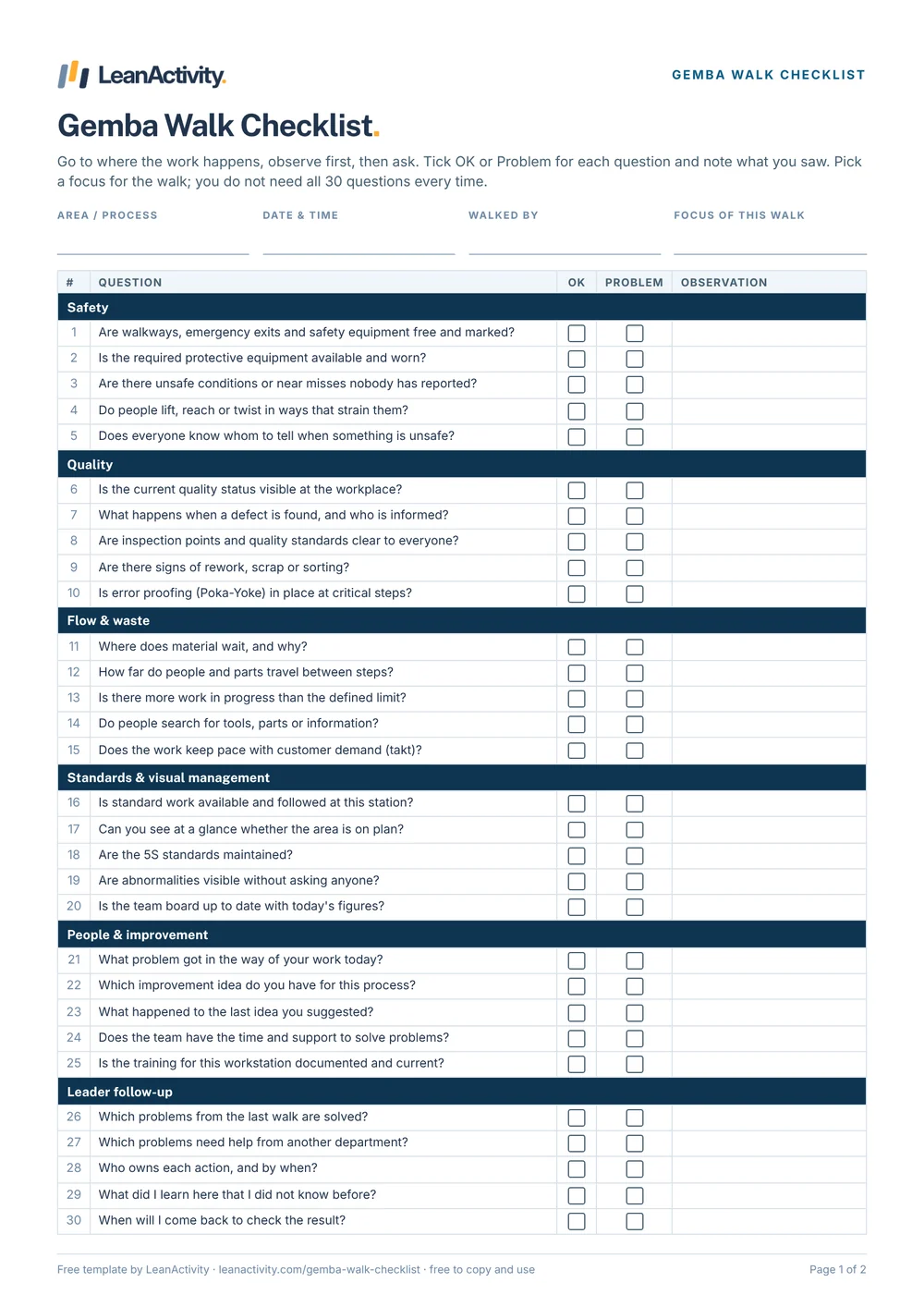
Between the checkpoints, check the standard where it lives. Short gemba walks show whether the new way of working holds; our gemba walk checklist has the questions. And plan the next event: a series of events along the value stream, supported by training, becomes a continuous improvement programme.
Mistakes that make Kaizen results fade
- The scope is too big. The team discusses all week instead of changing. Cut the scope until it fits.
- There is no baseline. Without before-figures, the result is an opinion.
- The sponsor is absent. If the manager skips the kick-off and the report-out, the team learns that the event does not matter.
- No operators in the team. Engineers design a process that the people who run it do not accept.
- Too much time in the meeting room. If day three starts with more brainstorming, go to the gemba.
- People fear for their jobs. Then the ideas dry up. Say openly at the kick-off how freed-up capacity will be used.
- Nobody follows up. The surest way to lose the result. Plan step 7 before step 4.
Kick off day one with a Lean game
Day one often brings together people who have never worked on Lean together: an operator, a technician, a planner, a manager. Before they analyse their own process, they need a common language and a feel for waste, flow and standard work. A Lean game delivers both: the team runs a simulated factory, improves it with methods such as 5S, layout, SMED and flow, and measures the difference. Because nobody’s own workplace is under discussion yet, people speak freely.
- In the room: the LeanActivity Factory Game is a tabletop factory for 6 to 16 players. It sets up in about 15 minutes, runs for about 4 hours and comes with video-guided facilitation.
- For distributed teams: the Online Game is a 3D factory in the browser with no installation. A moderator leads 2 to 20 players in teams of 5, for example in an MS Teams call, and bots fill free seats.
- For the sponsor and leaders: a condensed 60-minute version of the Factory Game for executive teams gives the people who approve changes the same language as the team.

Frequently asked questions.
What is a Kaizen event?
A Kaizen event is a focused improvement workshop, usually three to five days long, in which a cross-functional team improves one clearly defined process. The team analyses the current state at the gemba, tries changes straight away and hands over a new standard at the end.
What is the difference between a Kaizen event and a Kaizen blitz?
In practice there is none. Kaizen blitz, Kaizen workshop and rapid improvement event are different names for the same format: a short, intensive improvement effort on one process with a clear, measurable target.
How long should a Kaizen event be?
Five days is the classic format when equipment or layouts change. Three days are often enough for a narrow scope or an office process. Shorter sessions can solve a single problem, but they rarely leave time to test changes and make them the standard.
Who should take part in a Kaizen event?
Around six to eight people: operators from every shift involved, the support functions needed to make changes, such as maintenance, quality or logistics, and one person from outside the area. A facilitator guides the method, and a sponsor from management removes obstacles.
How do you prepare a Kaizen event?
Start two to four weeks ahead. Agree a charter with scope and target, collect baseline data, release the team from their normal work, book maintenance and other support, and plan production around the days on which equipment will be moved.
How do you make the results of a Kaizen event last?
Make the new way of working the standard, train every shift and agree an action list with owners and dates. Then review the open actions and the key figures at 30, 60 and 90 days, and check the standard regularly on gemba walks.