On this page
What is idea management?
Idea management is the structured process of collecting improvement ideas from employees, deciding on them quickly, implementing the good ones and showing everybody the result. It is also called an employee suggestion system, and in Lean companies it is the everyday engine of continuous improvement (Kaizen).
The idea behind it is simple: nobody knows a process as well as the people who work in it every day. The operator who walks to the same shelf fifty times a shift knows where it should be. The clerk who types the same data twice knows which field could be filled automatically. Idea management makes sure this knowledge is used instead of lost.
Idea management is not the same as innovation management. Innovation management looks for new products and business models, often in a dedicated team. Idea management collects many small, everyday improvements from everyone: safer workplaces, shorter walks, fewer errors, simpler forms.
Why most suggestion boxes fail
Almost every company has tried a suggestion box at some point, and many of them are empty today. The reasons are nearly always the same:
- The black hole. Ideas disappear without an answer. After the second unanswered idea, employees stop submitting.
- Slow decisions. A committee meets once a quarter. By then the idea is forgotten, or the problem has been worked around.
- Too much paperwork. A two-page form for a five-minute improvement is a waste in itself.
- No visible result. Even implemented ideas stay invisible, so nobody sees that ideas make a difference.
The idea management process in five steps
A working idea management process is a short loop, not a long procedure. These five steps are enough for most companies:
- Collect in a minuteMake submitting easy: a QR code at the workplace or a link, a short description, an optional photo. No login, no form with ten fields.
- Decide within daysThe responsible manager, not a committee, decides quickly: yes, no with a reason, or needs clarification.
- Implement with an ownerEvery approved idea gets an owner and a date. Small ideas are often best implemented by the person who had them.
- Show the resultMake implemented ideas visible on a board, in the team meeting and in a short report. Thank the person by name.
- Learn and improveReview the figures every month: Where do ideas get stuck? Which areas submit few ideas, and why?
Make ideas visible on a board
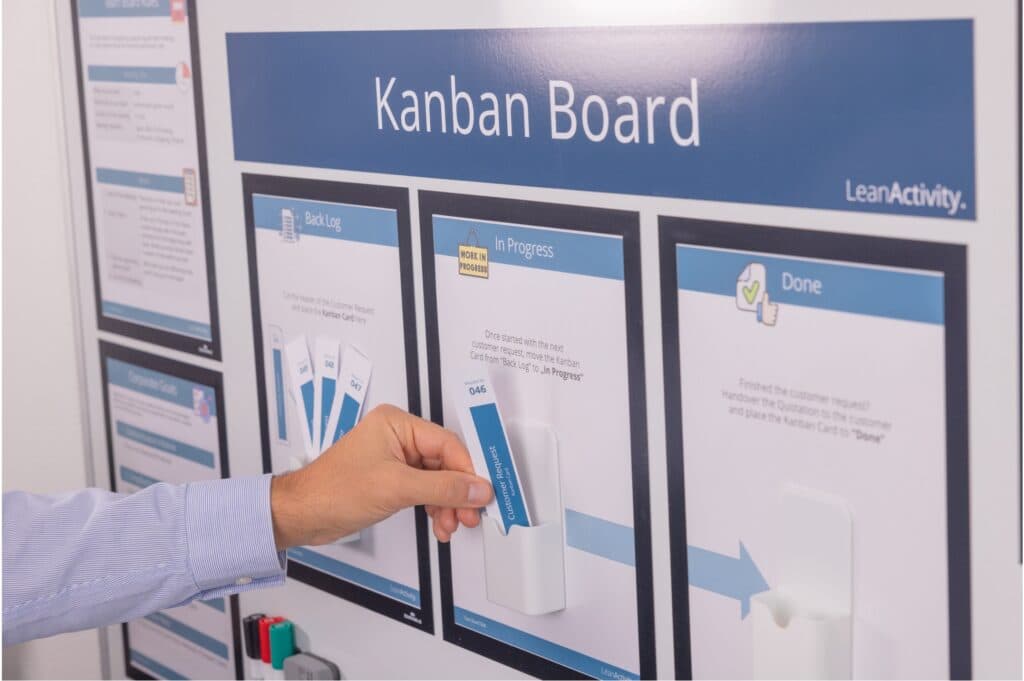
Lean teams manage work visually, and ideas are no exception. A simple Kanban board with four columns shows every idea and its status at a glance:
| New | Approved | In progress | Done |
|---|---|---|---|
| Submitted ideas waiting for a decision | Accepted ideas with an owner | Ideas being implemented | Implemented ideas, with the result |
The board answers the question every employee has: What happened to my idea? It also shows managers where ideas pile up. If the “New” column keeps growing, decisions are too slow; if “In progress” is full, implementation needs more time or support.
KPIs for idea management
A few key figures are enough to steer the process. Track them monthly, by team or area:
| KPI | What it shows |
|---|---|
| Participation rate | Share of employees who submitted at least one idea |
| Ideas per employee | How active the idea culture is |
| Time to decision | Whether ideas get a quick answer |
| Implementation rate | Share of approved ideas that are actually done |
| Effect | Savings, safety or quality gains of implemented ideas, where measurable |
Recognition and rewards
Money is rarely the main reason people submit ideas. Being heard is. Recognition that works:
- A fast, personal answer from the manager, also when the answer is no.
- Naming the person in the team meeting when the idea is done.
- Letting people implement their own small ideas, with the time to do it.
- Small, quick rewards, and larger ones only for ideas with a measurable effect.
Spreadsheet, email or idea management software?
Many companies start with a spreadsheet or a shared inbox. That works for a few ideas, but it breaks down as soon as several departments are involved: nobody sees the status, follow-ups get lost, and the report at the end of the year takes days.
What to look for in a tool
- Submitting in a minute, from the shopfloor: QR code or link, mobile, with a photo.
- No account or password for employees, so everybody can take part.
- A visual board from “New” to “Done”, visible to the idea managers.
- Assignment to the responsible department, with notifications and a simple way to report progress.
- A report of submitted ideas, implemented improvements and their effect.
- Data hosting that fits your data protection requirements.
One tool built exactly for this loop is IdeaKanban, an idea management software for small and medium-sized companies. Employees submit ideas by QR code or link without an account, idea managers move them on a board from New to Done, departments receive approved ideas by email with a secure update link, and an impact report shows submitted ideas, completed improvements and recorded savings. Data can be hosted in Germany, the USA, the UK, Canada or Singapore.
Full disclosure: IdeaKanban is made by the people behind LeanActivity.
Get started in 30 days
- Week 1: define the loopWho decides on ideas in each area, how fast, and where ideas are shown. Keep it on one page.
- Week 2: spark the first ideasRun a short kick-off, ideally with a hands-on Lean game, so that teams see waste and come up with ideas.
- Week 3: decide and implementAnswer every idea within days and implement the quick wins right away.
- Week 4: show the resultsShare the first implemented ideas and the people behind them. Then review the KPIs and adjust.
A Lean game is one of the fastest ways to get the first ideas: after playing the Lean game, participants look at their own workplace with new eyes. Read more about the bigger picture in our guide to Lean management.
Frequently asked questions.
What is idea management?
Idea management is the structured process of collecting improvement ideas from employees, deciding on them quickly, implementing the good ones and showing the result. It turns the knowledge of the people who do the work into continuous improvement.
What is the difference between idea management and innovation management?
Innovation management focuses on new products, services and business models, often in dedicated teams. Idea management focuses on many small, everyday improvements suggested by all employees: safer workplaces, shorter walks, fewer errors and simpler processes.
Why do employee suggestion systems fail?
Most fail because ideas disappear without an answer. Long forms, slow decisions by committees, no visible progress and no recognition teach employees that submitting ideas is not worth the effort.
Which KPIs should I use for idea management?
Useful KPIs are the participation rate (share of employees who submitted at least one idea), ideas per employee, the time to a decision, the implementation rate and, where it can be measured, the savings or other effects of implemented ideas.
Do employees need to be paid for ideas?
Not necessarily. Fast feedback, visible implementation and public recognition motivate more than complex bonus schemes. Many companies combine recognition with small rewards and keep larger rewards for ideas with a measurable effect.
Which software is good for idea management?
Look for a tool that lets employees submit ideas in a minute without an account, shows every idea on a visual board, assigns ideas to the responsible department and reports the results. IdeaKanban is one example built for small and medium-sized companies.