On this page
What is Lean management?
Lean management is a way of running an organisation that focuses on one thing: delivering what the customer values, with as little waste as possible. It is not a single tool or a cost-cutting programme. It is a management system: principles, daily routines and a culture of continuous improvement in which the people who do the work also improve it.
Lean management has its roots in the Toyota Production System. The word “lean” was coined by John Krafcik in 1988 and made popular by James Womack, Daniel Jones and Daniel Roos in The Machine That Changed the World (1990). Today Lean is used far beyond car plants: in manufacturing of every kind, in logistics, hospitals, software and administration.
If you are looking for a broad overview of Lean principles and tools, read our guide to Lean methodology. This article focuses on the management side: what leaders do every day to make Lean work and last.
The five principles of Lean management
In Lean Thinking (1996), Womack and Jones summarised Lean in five principles. They still are the best starting point:
- ValueDefine value from the customer’s point of view: what are they willing to pay for?
- Value streamMap every step from order to delivery and separate value-adding steps from waste.
- FlowLet the work flow without stops, queues and detours, ideally one piece at a time.
- PullProduce only what the next step or the customer needs, when they need it.
- PerfectionImprove continuously. Every solved problem reveals the next one.
The eight wastes (TIMWOODS)
Waste, or muda in Japanese, is everything that costs time or money but adds no value for the customer. Lean management distinguishes eight types, often remembered as TIMWOODS:
| Waste | In production | In the office |
|---|---|---|
| Transport | Moving parts between distant stations | Forwarding documents through many inboxes |
| Inventory | Piles of work in progress | Unprocessed requests and full mailboxes |
| Motion | Walking and searching for tools | Searching for files and information |
| Waiting | Waiting for material or a machine | Waiting for an approval or a decision |
| Overproduction | Producing more or earlier than needed | Reports nobody reads |
| Overprocessing | Tighter tolerances than required | Double data entry, too many signatures |
| Defects | Scrap and rework | Errors in forms, corrections |
| Skills (unused talent) | Operators’ ideas are never asked for | Experts doing copy-and-paste work |
The Lean management system: what leaders do every day
Many Lean initiatives start strong and fade after a year. The difference between a Lean project and Lean management is the daily management system: a few simple routines that keep standards alive and surface problems while they are still small.
Gemba walks
Gemba means “the real place”. Leaders go regularly to where the work happens, observe, ask questions and listen. Decisions are based on what they have seen, not on reports alone.
Visual boards and daily meetings
Every team has a board that shows the few figures that matter (for example safety, quality, delivery, cost and people) and the open problems. A short stand-up meeting at the board each morning reviews yesterday, plans today and assigns open points. Problems go up the hierarchy in a fixed rhythm until they are solved.
Standard work
The best known way of doing a task is written down and followed. A standard is not a rule for ever; it is the baseline for the next improvement. Leaders have standard work too: when they walk the gemba, which boards they visit, which problems they follow up.
Problem solving and strategy deployment
Problems are solved with a simple, shared method such as PDCA, the 5 Whys or an A3 report. At the top, Hoshin Kanri (strategy deployment) breaks a few yearly goals down into the improvement work of every team, so that everybody knows how their daily work contributes.
Core Lean management tools
| Tool | What it is for |
|---|---|
| Value stream mapping | Seeing the whole process and where the time is lost |
| 5S | An orderly, safe workplace where everything has its place |
| Kanban | Pull-based control of material and work |
| SMED | Short changeovers, so that small batches become possible |
| Takt time | Matching the production rhythm to customer demand |
| Poka-Yoke | Error proofing, so that defects cannot happen |
| Kaizen | Small, continuous improvements by the team itself |
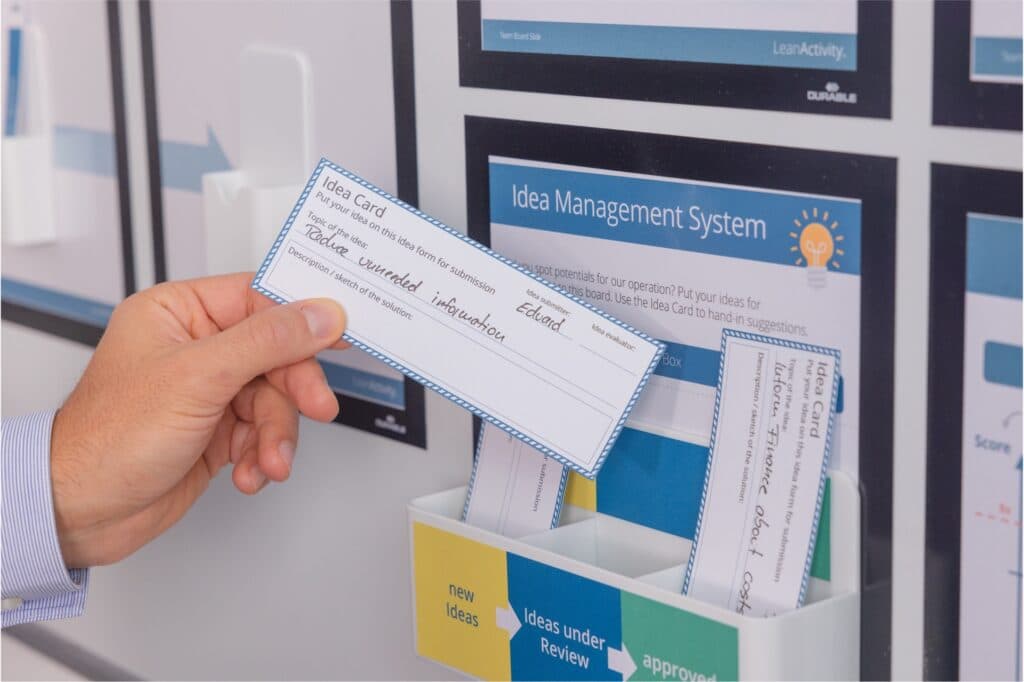
| Idea management | Collecting and implementing employees’ improvement ideas |
Lean leadership: coach, don’t command
Lean management changes the role of the manager. Instead of handing out solutions, a Lean leader asks questions, develops people and makes problems visible without blaming anyone. Three habits make the difference:
- Go and see. Understand the problem where it happens before deciding anything.
- Ask why. Help the team find the root cause instead of fixing the symptom.
- Respect for people. The people closest to the work know it best. Their ideas are the engine of continuous improvement.
A 90-day plan to start with Lean management
Days 1–30: learn and see
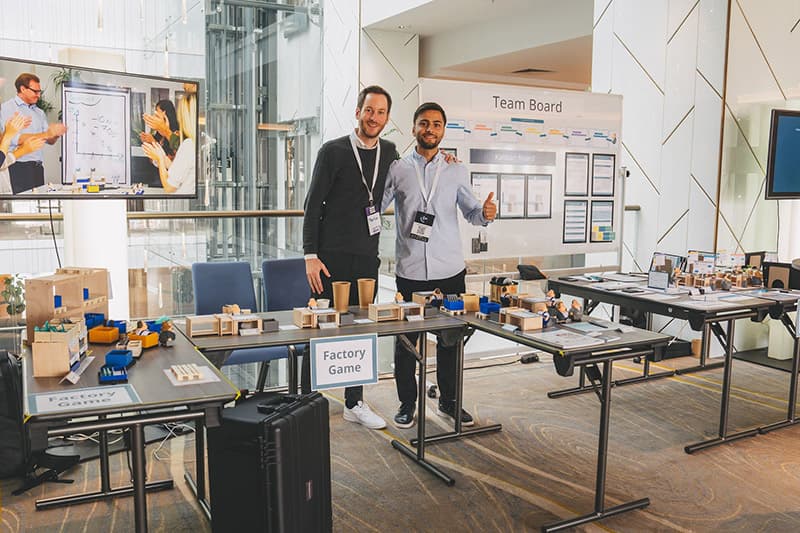
- Train the leadership team together, ideally with a hands-on Lean game rather than slides.
- Do gemba walks and map one value stream from order to delivery.
- Choose one pilot area with a visible problem and a motivated team leader.
Days 31–60: pilot
- Introduce 5S in the pilot area.
- Start a daily meeting at a visual board with three to five key figures.
- Run a first Kaizen workshop on the biggest waste and collect improvement ideas from the team.
Days 61–90: standardise and scale
- Write down standard work for the improved process and for the leaders’ routines.
- Set up a simple idea management process so improvements keep coming.
- Share the results and choose the next area, with the pilot team as trainers.
For the training part of the plan, our guide to Lean training for teams compares formats, agendas and costs.
Common Lean management mistakes
- Starting with tools instead of problems. 5S everywhere does not help if nobody knows which problem it solves.
- Delegating Lean to a project team. Without leaders who walk the gemba and run the daily routines, improvements fade.
- Selling Lean as cost cutting. If people fear for their jobs, they will not share the problems Lean needs to see.
- No follow-up on ideas. An idea that disappears without an answer is the last one an employee submits.
Frequently asked questions.
What is Lean management?
Lean management is a way of running an organisation that focuses on delivering value to the customer with as little waste as possible. It combines five principles (value, value stream, flow, pull, perfection), daily routines such as visual boards and gemba walks, and continuous improvement by the people who do the work.
What are the five principles of Lean management?
Define value from the customer’s point of view, map the value stream, create flow, establish pull, and pursue perfection through continuous improvement. The principles were described by James Womack and Daniel Jones in their book Lean Thinking.
What is the difference between Lean management and Lean manufacturing?
Lean manufacturing applies Lean principles to production. Lean management is broader: it is the management system that makes Lean work across the whole organisation, including leadership routines, goal setting and problem solving, in production as well as in offices and services.
What does a Lean manager do every day?
A Lean manager spends time where the work happens (the gemba), runs short daily meetings at a visual board, follows up on problems and improvement ideas, coaches the team in problem solving and keeps standards up to date.
How do you start with Lean management?
Start small: train the leadership team, for example with a Lean game, choose one pilot area, introduce 5S, a daily meeting at a visual board and a simple idea process, and standardise what works before you roll it out to the next area.
Does Lean management work in offices?
Yes. Offices have the same wastes as factories: waiting for approvals, searching for information, handovers, rework and unclear priorities. Visual boards, standard work and continuous improvement work in administration and services as well.