On this page
What is a Lean game?
A Lean game is a hands-on simulation in which a team runs a small production or office process, measures the result, improves the process with Lean methods and then plays again. Instead of listening to a lecture about waste, flow and pull, participants experience them: they search for parts, wait for the station before them, carry material across the hall, and then see what happens to the numbers when they fix it.
Lean games are also called Lean simulation games, Lean manufacturing games or Lean training games. They are used in onboarding, in Lean and Six Sigma courses, in Kaizen kick-offs and in leadership workshops, because they make one thing obvious in a few minutes: most of the lost time in a process is not the work itself, but everything around it.
Note: in this guide, “Lean game” means a game for learning Lean management and Lean production, not a game for the Lean theorem prover.
Why teams learn Lean faster by playing
Lean is easy to explain and hard to feel. Everyone agrees that waiting and searching are waste, until they stand at their own workstation. A Lean game closes that gap. Three effects make it work:
- Experience before explanation. In the first round the process is deliberately chaotic. Participants feel the stress of searching, waiting and rework before anybody names it.
- Numbers instead of opinions. Output, lead time, work in progress and quality are measured after every round, so the team sees which change really helped.
- A safe place to experiment. In a game, moving a station or changing the batch size costs nothing. Teams try ideas they would never test on the real line first.
The result is a shared language. After a good Lean game, a supervisor and an operator both know what “one-piece flow” or “a supermarket” means, because they built one together. That is the real value of gamification in Lean training, and it is why we wrote a separate article on the power of gamification.
How a Lean game works: the round structure
Almost every effective Lean game follows the same loop. It mirrors the PDCA cycle (Plan, Do, Check, Act) that sits at the heart of continuous improvement:
- Play a roundThe team produces under realistic conditions: demand, stations, material, time pressure.
- MeasureThe game shows the key figures: output, lead time, inventory, quality, walking distance.
- DebriefThe moderator asks what went wrong and why. The team finds the wastes in its own round.
- ImproveThe team applies one Lean method, for example 5S, a new layout or a quick changeover.
- Play againThe next round shows the effect of the change in the team’s own numbers.
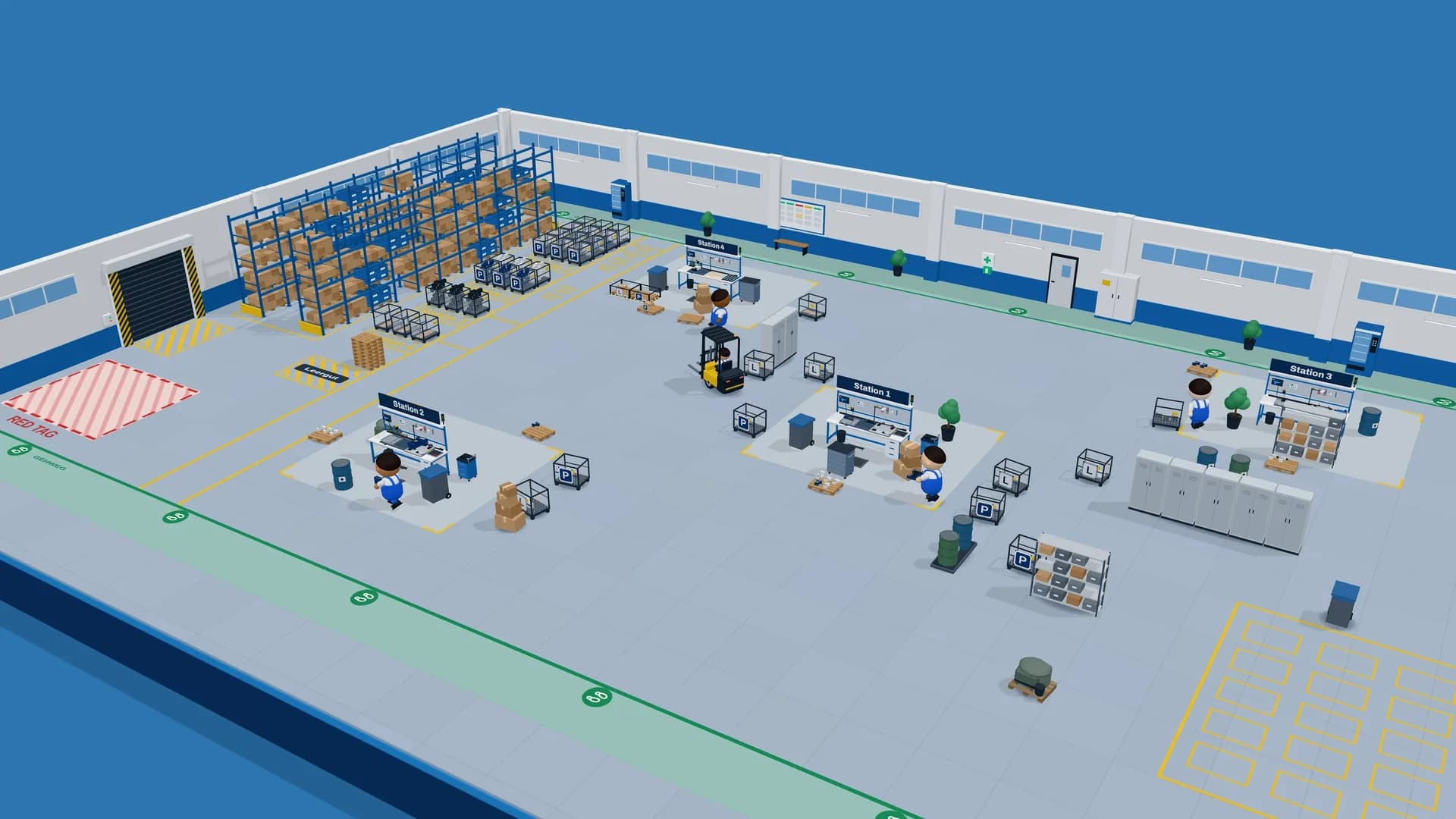
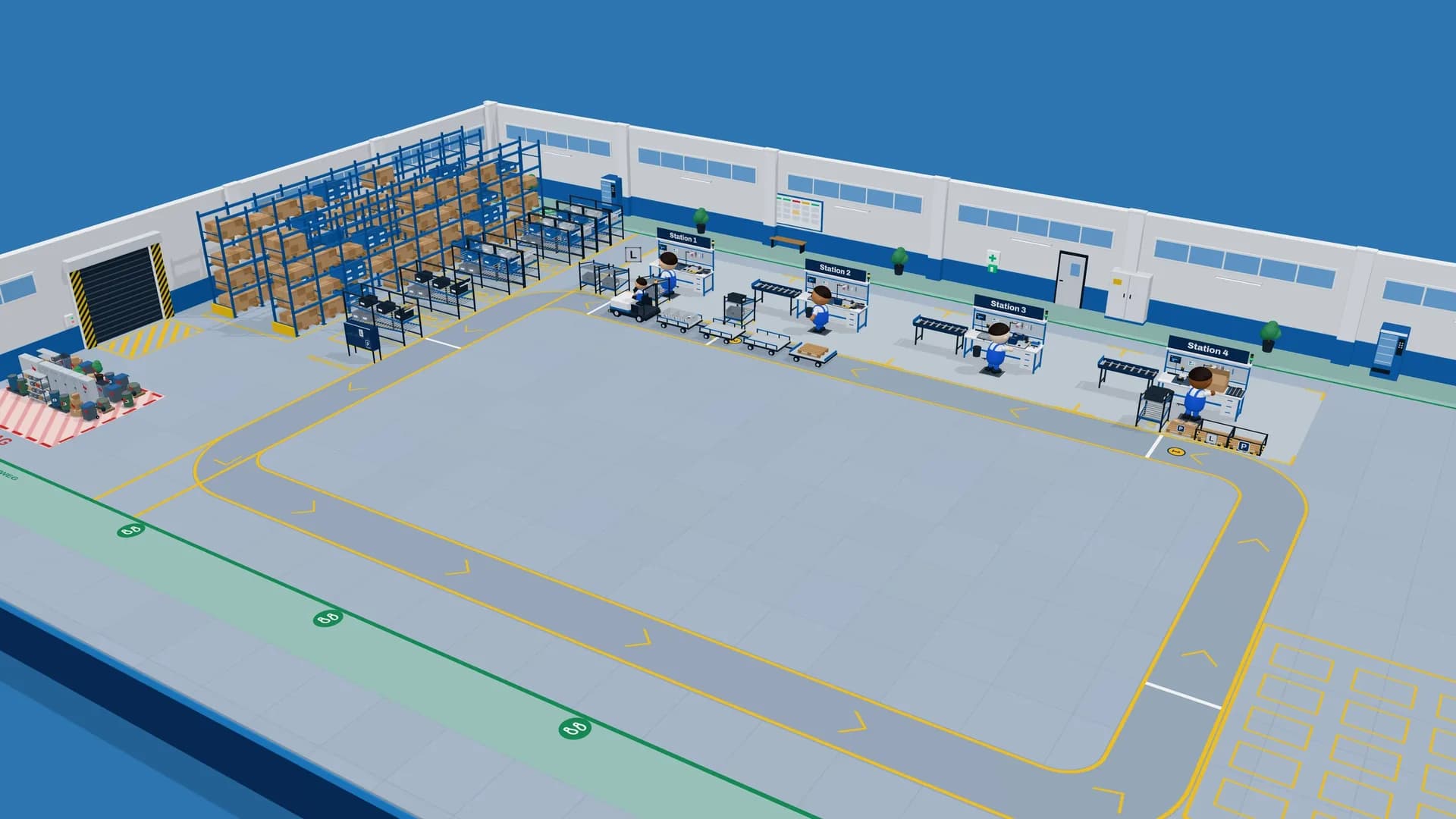
A full Lean game repeats this loop several times. In the LeanActivity Online Game it runs over 12 rounds: five production shifts and seven improvement workshops, from the chaotic factory in round 1 to the Lean factory in round 12.
Which Lean tools can you practise in a Lean game?
A good Lean game does not teach tools in isolation. It introduces each tool when the team needs it, so the tool solves a problem the players have just experienced. These are the Lean methods a complete game covers:
| Lean tool | What players experience | In the LeanActivity Online Game |
|---|---|---|
| The 8 wastes | Searching, waiting, walking, rework and overproduction in their own round | Round 1, the chaotic factory |
| 5S | Sorting the workplace, a red tag area, fixed places for parts and tools | Round 2, 5S workshop |
| Lean layout | Shorter walks and fewer handovers once stations move closer | Round 3, Lean layout |
| SMED | Changeovers that take minutes instead of a long stop | Round 5, SMED workshop |
| One-piece flow | Less work in progress and a shorter lead time | Rounds 6 and 7 |
| Takt time & line balancing | A time study, then work spread evenly along the line | Rounds 8 and 10 |
| Poka-Yoke | Error proofing so that mistakes cannot happen | Round 9, Poka-Yoke workshop |
| Supermarket & route train | Material supply by pull instead of push | Rounds 11 and 12 |
If you want to go deeper into one of these topics, read our guides on takt time vs. cycle time, 5S and the red tag area and SMED in the Factory Game.
Types of Lean games: physical, online and hybrid
Lean games come in three main formats. None is better in general; each fits a different situation.
Physical Lean games
Classic paper-airplane and building-block exercises are cheap and quick, but they need someone to prepare material and collect data by hand. Dedicated physical kits such as the LeanActivity Factory Game go further: a complete tabletop factory with stations, parts and figures, built for repeated trainings. Physical games are hard to beat for energy in the room and for teams that work with their hands every day.
Online Lean games
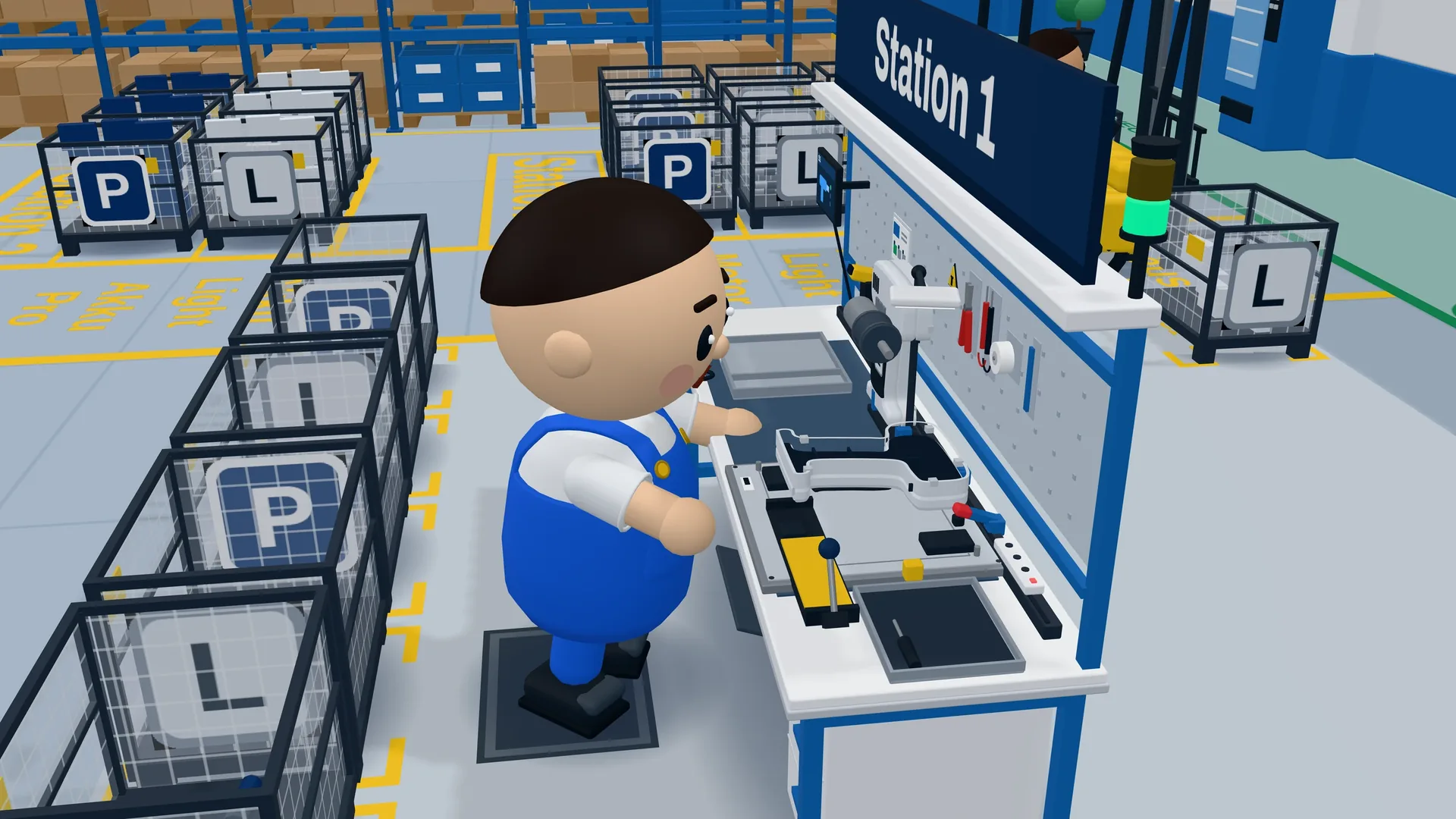
Browser-based Lean simulations bring the same learning to distributed teams. Nothing needs to be shipped or set up, and the figures are recorded automatically. The quality varies a lot: some are abstract exercises on a screen, others such as the LeanActivity Online Game are a 3D factory in which every player is an avatar who walks, carries parts and assembles.
Hybrid formats
Many companies combine both: the online game for remote sites and onboarding, the physical kit for workshops on site. The Lean content stays the same, so every team speaks the same Lean language.
| Physical kit | Online game | Hybrid | |
|---|---|---|---|
| Best for | Workshops in one room, shopfloor teams | Distributed teams, many sites, onboarding | Companies that train on site and remotely |
| Group size | Typically 6–16 per kit | LeanActivity: 2–20 players in teams of 5 | Both |
| Data | Collected in the game | Recorded automatically | Both |
| Setup | About 15 minutes for the Factory Game | None, runs in the browser | Depends on the session |
| Energy | Very high, hands-on | High with a good moderator | High |
How to choose the right Lean game
Before you compare products, answer five questions. They narrow the choice quickly:
- Where are your participants? In one room, a physical game creates the most energy. Spread over several sites, an online Lean game saves travel and shipping.
- How many people per session? Check the group size the game is built for, and what happens when fewer people join.
- Which Lean topics do you need? A short exercise may cover flow and batch size; a complete Lean simulation should take the team from waste and 5S to flow, takt and pull.
- Who will moderate? Look for a clear trainer guide, debrief questions and figures the moderator can show after every round.
- How often will you run it? For one workshop, a single session may be enough. For a training programme, a kit or licence with unlimited sessions is usually cheaper per participant.
How to run a Lean game session, step by step
- Set one learning goalFor example: “Everybody can explain one-piece flow and why it shortens lead time.”
- Prepare the room or the callKit on the table, or one browser link and a video call. Test sound and screen sharing beforehand.
- Start in chaosLet the first round run without help. The frustration is part of the lesson.
- Debrief with numbersShow the figures, ask what slowed the team down, and write the wastes down.
- Introduce one method per round5S, layout, SMED, flow, balancing: each change solves a problem the team has just felt.
- Compare first and last roundPut the first and the last results side by side. The difference is your best argument for Lean.
- Transfer to real workEnd with one improvement each participant will try at their own workplace within a week.
Common mistakes (and how to avoid them)
- Explaining the solution before the first round. Let the team find the problems itself; otherwise the game becomes a demonstration.
- Skipping the debrief. The learning happens between the rounds, not during them. Plan at least as much time for debriefs as for play.
- Too many tools at once. One method per round keeps cause and effect visible.
- No link to the real process. Close every session with a concrete improvement for the participants’ own workplace, and follow it up, for example with an idea management process.
Lean games by LeanActivity
LeanActivity has built Lean games for trainers, Lean coaches and production managers for years, and more than 1,500 Lean professionals worldwide use them. Three formats cover most situations:
- LeanActivity Online Game – a 3D factory in the browser. A moderator leads 2 to 20 players in teams of 5 through 12 rounds; bots fill free seats. Ideal for distributed teams.
- LeanActivity Factory Game – the physical tabletop factory for 6 to 16 players, about 4 hours, set up in 15 minutes and reusable for unlimited sessions.
- LeanActivity Office Game – the same Lean principles for administrative processes, for 6 to 12 participants.
Not sure which one fits? Compare the formats and prices on the pricing page or read our guide to planning a Lean training for teams.
Frequently asked questions.
What is a Lean game?
A Lean game is a hands-on simulation in which a team runs a small production or office process, measures the result, improves the process with Lean methods and plays again. It turns principles such as flow, pull and waste reduction into an experience people remember.
How long does a Lean game take?
It depends on the game. Short exercises take 30 to 60 minutes, a complete Lean simulation with several improvement rounds usually takes a half-day. The LeanActivity Factory Game is designed for about 4 hours, the Online Game runs in a single session led by a moderator.
How many people can play a Lean game?
Most physical games work best with 6 to 16 people per kit. The LeanActivity Online Game is played by 2 to 20 players in teams of 5, and bots fill the free seats when fewer people join.
Can a Lean game be played online?
Yes. Browser-based Lean games let distributed teams play together, for example in an MS Teams call. The LeanActivity Online Game is a 3D factory in the browser: every player is an avatar who walks, carries parts and assembles, and a moderator leads the rounds.
Which Lean tools does a Lean game teach?
A complete Lean game typically covers the wastes, 5S, layout and flow, SMED (quick changeover), one-piece flow, takt time and line balancing, Poka-Yoke (error proofing) and material supply such as a supermarket and route train.
Is a Lean game only for manufacturing?
No. The same principles apply to offices and services. Office versions such as the LeanActivity Office Game simulate administrative processes, with handovers, approvals and waiting times instead of assembly stations.