On this page
The short answer
If you are comparing online Lean simulations, you have probably come across Zensimu and its Lean Game. It is a solid product. But depending on what you want your participants to experience, a Zensimu alternative may fit better.
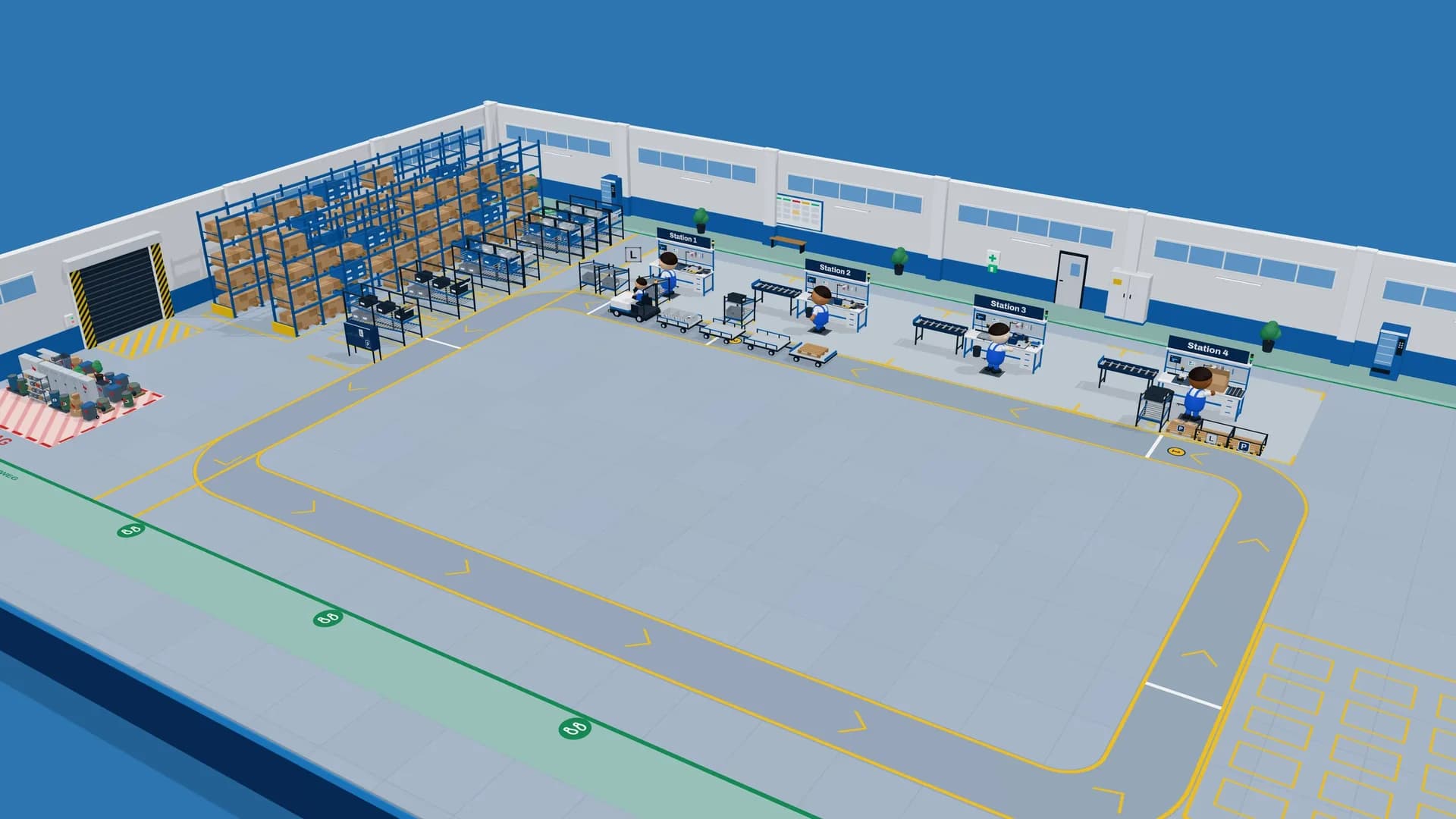
The LeanActivity Online Game takes a different approach: instead of clicking at stations, every player is an avatar in a 3D factory hall. Players walk, carry parts and assemble products, and between the shifts the team rebuilds the factory, from a chaotic hall to a Lean factory with a balanced line, a supermarket and a route train.
What the Zensimu Lean Game is
Zensimu describes its Lean Game as a “visual multiplayer factory simulation”. According to its help centre, the game simulates a workshop that makes coloured products for a client: players work at painting stations and add coloured dots to units, and a quality control station removes defects. Rounds last 5 to 20 minutes, with improvements between the rounds.
Strengths that Zensimu highlights:
- Browser-based, can be played remotely, and the computer can take over roles nobody plays.
- Customisable layout, products and customer demand.
- Automatic post-game analysis with charts and PDF exports for the debrief.
- Covers Lean concepts such as Kanban, SMED, Heijunka, Jidoka and Poka-Yoke.
- Scales to very large groups, and Zensimu also offers supply chain games such as the Beer Game.
What the LeanActivity Online Game is
The LeanActivity Online Game is a Lean simulation in a 3D factory hall that runs in the browser, with no installation. A moderator opens the session, for example during an MS Teams call, and leads 2 to 20 players in teams of 5. When fewer people join, bots fill the free seats.
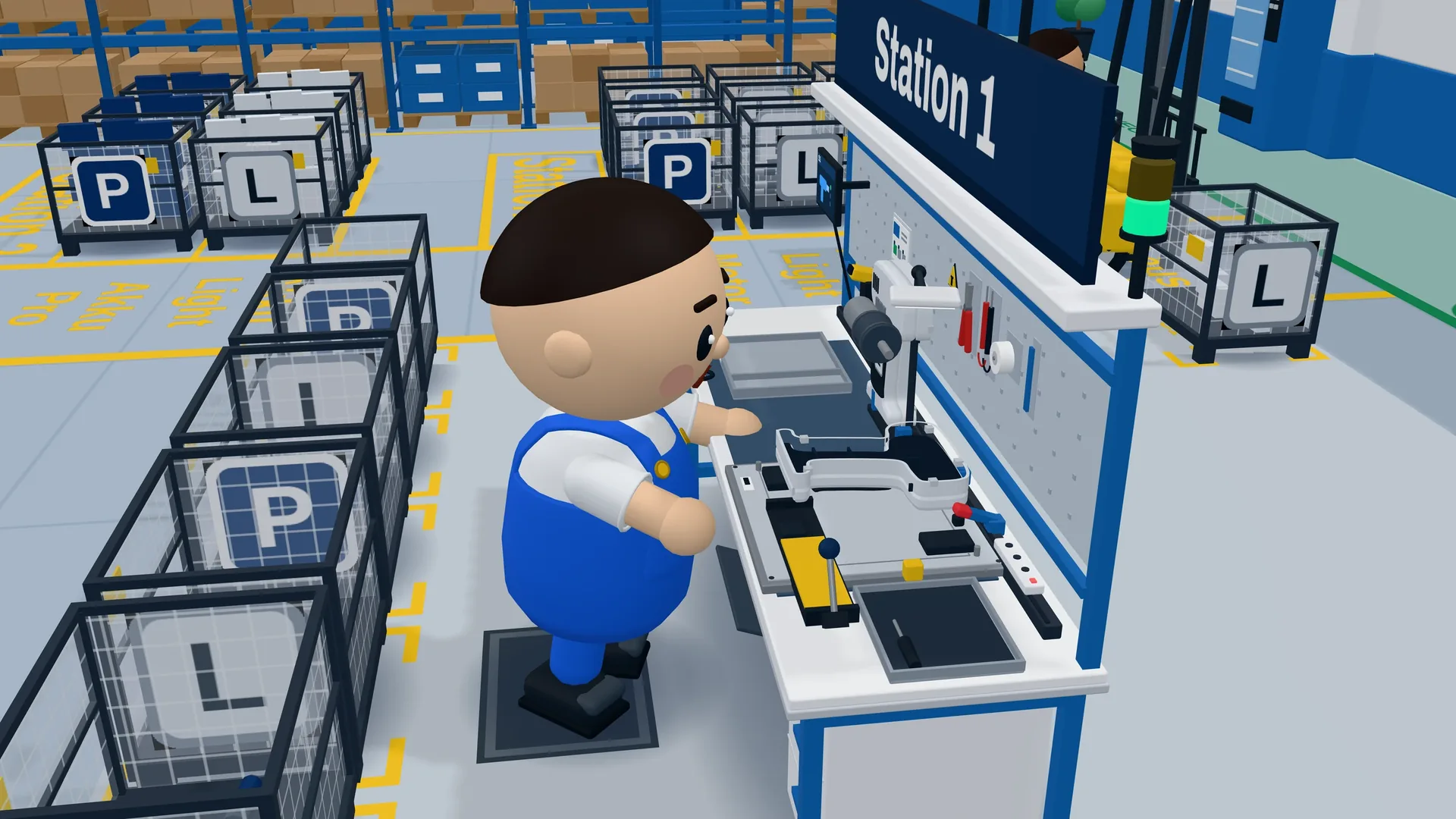
The game runs over 12 rounds: five production shifts and seven improvement workshops. In the workshops the team applies 5S with a red tag area, redesigns the layout, cuts changeover time with SMED, plans one-piece flow, runs a time study and balances the line, adds Poka-Yoke and plans a supermarket with a route train. After every shift, the KPIs show what changed. The full sequence is described on how the Online Game works.
LeanActivity vs. Zensimu: side-by-side comparison
| Zensimu Lean Game | LeanActivity Online Game | |
|---|---|---|
| Format | Browser-based workshop simulation | Browser-based 3D factory hall |
| How players act | Click at stations under time pressure (e.g. painting dots on units) | Avatars walk, carry parts, assemble and use the stations |
| Storyline | Several rounds with improvements set by the instructor | 12 rounds from a chaotic to a Lean factory (5 shifts, 7 workshops) |
| Group size | From single player to very large groups (enterprise: 1,000+) | 2–20 players per session in teams of 5 |
| Missing players | The computer plays unfilled roles | Bots fill the free seats |
| Customisation | Layout, products and demand can be customised | Fixed, guided Lean transformation |
| Results | Automatic analysis, charts, PDF export | KPIs after every shift, moderator view |
| Physical option | Not part of the Lean Game | Yes: Factory Game and Office Game kits, on-site training |
| Other games | Supply chain games, e.g. the Beer Game | Office Game (Lean office) |
| Free option | Free single-player account | Free demo |
Interactivity: clicking at a station vs. walking the factory
The biggest difference is how it feels to play. In a click-based simulation, players experience the process through their own station and the results charts. In a 3D factory they also move through it: the avatar walks the long way to a shelf, waits in front of the station before it, and searches for the right part.
That matters in the improvement rounds. When the team moves stations closer together, the walking distance does not only drop in a chart; everybody sees their avatar take a few steps instead of crossing the hall. When the route train starts to supply the line, players notice that they no longer leave their station. Lean principles such as flow and pull become something people have done, not only something they have read.
When click-based is the better choice
A lighter, click-based simulation can be the right tool when you run very short sessions, need very large groups at once, or want to build your own scenarios. That is where Zensimu is strong.
Pricing models
The two vendors price differently, so compare on the basis of how you will use the game.
- Zensimu (per its pricing page): a free single-player account, a self-service conference plan for one month with participant tiers, and an enterprise plan with yearly access on request. Universities get a discount.
- LeanActivity Online Game: monthly plans by the number of people playing at the same time: Starter €299 (5 players), Team €399 (10 players) and Enterprise €499 (20 players) per month, each with unlimited trainings, unlimited participants and all content. See pricing.
If you train many different groups of moderate size over the year, a flat plan with unlimited trainings and participants is easy to budget. If you run one large event, a per-event plan can be simpler.
Which one should you choose?
Choose Zensimu if you …
- need one session for hundreds of participants at the same time,
- want to customise the layout, products and demand yourself,
- also want supply chain simulations such as the Beer Game.
Choose the LeanActivity Online Game if you …
- want participants to move through a 3D factory and feel waiting, walking and searching,
- prefer a guided Lean transformation over 12 rounds with a ready-made storyline for the moderator,
- run regular trainings for teams of up to 20 people and want unlimited sessions at a flat monthly price,
- also want physical kits or on-site training with the same Lean content.
How to test both
The fairest comparison is your own. Play the Zensimu Lean Game with its free account, and the free demo of the LeanActivity Online Game. Ask two colleagues to join and pay attention to three questions: Who talks about the process after five minutes? Who remembers the Lean methods a week later? And which one would your moderators enjoy running every month?
Zensimu and Lean Game are names of their respective owner. LeanActivity is not affiliated with Zensimu. All information about Zensimu is taken from its public website and help centre (November 2026) and may change.
Frequently asked questions.
What is a good alternative to Zensimu?
If you are looking for a Lean simulation in which players move through a 3D factory and transform it round by round, the LeanActivity Online Game is an alternative. A moderator leads 2 to 20 players in teams of 5 through 12 rounds in the browser, and LeanActivity also offers physical kits for on-site workshops.
Is the LeanActivity Online Game the same as the Zensimu Lean Game?
No. Both are browser-based Lean simulations, but they work differently. In the Zensimu Lean Game, players produce units by clicking at stations, for example painting coloured dots. In the LeanActivity Online Game, every player is an avatar in a 3D factory hall who walks, carries parts and assembles, and the team changes the factory in seven improvement workshops.
Which is better for large groups?
For very large groups in one session, Zensimu is built to scale: according to its website, its enterprise plan covers up to 1,000+ participants. A LeanActivity Online Game session is designed for 2 to 20 players in teams of 5; larger groups run several sessions, which the monthly plans allow without limits on trainings or participants.
How much does the LeanActivity Online Game cost?
The plans cost €299 (Starter, up to 5 concurrent players), €399 (Team, up to 10) and €499 (Enterprise, up to 20) per month, each with unlimited trainings, unlimited participants and all game content.
Can I play LeanActivity games offline or on site?
Yes. Besides the Online Game, LeanActivity offers physical tabletop kits: the Factory Game for 6 to 16 players and the Office Game for 6 to 12 participants, plus on-site training with LeanActivity coaches.