The short answer
A Kaizen workshop is a short, focused session in which the people who do the work improve one process together. Half a day to two days, in three moves:
1Understand
One problem, one measurable target and a walk through the real process to see and time it.
Steps 1–32Improve
Mark the waste, find the root causes and try the best ideas right away, measured against the start.
Steps 4–53Make it stick
Write the new standard, give every open point an owner and check the result after 30 days.
Step 6 and follow-up
Basics
What a Kaizen workshop is, and when it fits.
Kaizen means continuous improvement in small steps (see our glossary entry on Kaizen). A Kaizen workshop concentrates that idea into a few hours or days: a small team of the people who do the work takes one process, measures it, removes waste and leaves with a better way of working.
The terms are used loosely. The Lean Enterprise Institute treats Kaizen workshop, Kaizen event and Kaizen blitz as the same thing (Lean Lexicon, LEI). In many companies, though, a workshop is the shorter format for one problem, and a Kaizen event the three to five day format in which machines or layouts move.
| Daily Kaizen | Kaizen workshop | Kaizen event (blitz) | |
|---|---|---|---|
| Duration | Minutes, every day | Half a day to 2 days | 3 to 5 days |
| Scope | One small problem at the workplace | One problem or one process step | One whole process, often with layout changes |
| Team | The team at its board | 5–8 people, facilitator, sponsor | 6–10 people, support functions, sponsor |
| Preparation | None | 1–2 weeks | 2–4 weeks |
| Typical result | A small fix, done today | A new standard for one process step | A redesigned process, e.g. a new cell |
6 steps
How to run a Kaizen workshop in 6 steps.
Each step comes with a quick check you can do before you move on, and a worked example from a changeover workshop. The example figures are illustrations: put in your own.
Understand
Steps 1–3: target, team, current state
1Pick one problem and a measurable target
“Improve assembly” is a wish. “Halve the search time at station 3” is a workshop. Choose a problem that matters to the customer or the team, is small enough for the time you have and can be measured today.
Quick check
Worked example
2Invite the right people
Five to eight people: those who do the work, from every shift involved, one person from another area and a facilitator. Support functions stay on call, and the sponsor opens the day and comes back for the report-out.
Quick check
Worked example
3Go and see
Leave the meeting room and walk the process at the gemba. Time each step several times, count the work waiting between steps, draw the walking paths and film one full cycle.
Quick check
Worked example
Improve
Steps 4–5: waste, root causes, trials
4Find the waste and its root cause
Write every waste on a sticky note, one colour per type: waiting, walking, transport, searching, overprocessing, stock, defects and unused ideas (the 8 wastes). Cluster them, then ask “why?” until you reach a cause you can change, for the three biggest.
Quick check
Worked example
5Try ideas right away
Collect ideas silently first, then sort them on an impact/effort grid. Try the best ones the same day, in small PDCA cycles: change, run, measure, keep or adjust. A tried idea beats ten debated ones.
Quick check
Worked example
Make it stick
Step 6: standard, actions, report-out
6Make it the standard and follow up
Write the new way down as standard work, one page with photos, and train everyone who works in the process. What is not finished goes on an action list with an owner and a date. The team presents the result to the sponsor.
Quick check
Worked example
Agenda builder
Build your Kaizen workshop agenda.
Choose the format and the start time; the agenda adapts, with breaks, the output of every block and a version to copy into your invitation. It runs in your browser, nothing is sent or stored.
Your agenda
Kaizen workshop: your process
- 08:30–08:45Welcome, goal and rolesWhy this process, what the target is, who decides what. The sponsor opens, the facilitator runs the day.→ Everyone knows the goal
- 08:45–09:30Lean game: see waste in actionA short simulation round, then one change and a second round. The team sees waiting, searching and rework with fresh eyes.→ Shared language for waste and flow
- 09:30–10:45Current state at the gembaWalk the process in pairs. Time every step, count work in progress, film one cycle.→ Current state with real figures
- 10:45–11:00Break
- 11:00–11:45Map the process, mark the wasteDraw the steps on a wall. Mark waiting, walking, searching, rework and hand-overs.→ Process map with waste marked
- 11:45–12:30Lunch
- 12:30–13:15Root causes5 Whys or a fishbone diagram for the three biggest problems.→ Root causes, not symptoms
- 13:15–13:55Ideas and choiceBrainstorm silently first, then sort on an impact/effort grid and choose.→ 3–5 ideas to try
- 13:55–14:10Break
- 14:10–15:25Try it at the gemba (PDCA)Make the change for real, run the process, measure with the same method as in the morning.→ Before/after figures
- 15:25–16:00Standard, actions and report-outWrite the new standard, list open points with owners and dates, show the result to the sponsor.→ Standard, action list, decision
Ends 16:00 · 7 h 30 min incl. breaks
Roles
Who takes part in a Kaizen workshop.
The mix matters more than the number. People who do the work know the real process; one outsider asks the questions insiders stopped asking; the sponsor makes sure good ideas are not stopped later.
| Role | Who | Job in the workshop |
|---|---|---|
| Sponsor | The manager who owns the process | Explains why the problem matters, removes obstacles, decides at the report-out |
| Facilitator | Lean coach, CI manager or a trained team lead | Runs agenda and methods, keeps time, stays neutral on solutions |
| Process team (3–5) | People who do the work, from every shift | Know the real process, test the ideas, will run the new standard |
| Fresh eyes (1) | Someone from another area | Asks the “naive” questions, spots what insiders take for granted |
| Support (on call) | Maintenance, IT, quality, safety | Make changes possible on the day instead of weeks later |
Methods
Which method for which phase.
You do not need all of them. For a half-day workshop, a gemba walk, sticky notes for the waste, 5 Whys and an impact/effort grid are enough.
| Phase | Method | Time | You need |
|---|---|---|---|
| Understand | Gemba walk with time observation | 30–60 min | Stopwatch or phone, observation sheet |
| Understand | Spaghetti diagram of the walking paths | 15–20 min | Floor plan, pens |
| Understand | Process map on the wall (a simple value stream) | 30–45 min | Brown paper, sticky notes |
| Analyse | Waste walk with the 8 wastes | 20–30 min | Sticky notes, one colour per waste |
| Analyse | 5 Whys | 10 min per problem | Flip chart |
| Analyse | Fishbone (Ishikawa) diagram | 20–30 min | Flip chart |
| Ideas | Silent brainstorming (brainwriting) | 15–20 min | Cards, pens |
| Ideas | Impact/effort grid | 10–15 min | A grid on the wall |
| Try | PDCA trial at the gemba | 45–90 min | Materials, tape, the people who do the work |
| Sustain | One-page standard work with photos | 30–45 min | Camera, a template |
Facilitation
8 facilitation tips for a Kaizen workshop.
The facilitator owns the method, not the solution. These habits keep the energy up and the result in the hands of the team. More tips for trainers are in our guide to facilitating Lean simulations.
01
Start at the gemba
Ten minutes at the real process beat an hour of slides. Show the problem, then explain the method.
02
Silent first, then talk
Everyone writes ideas alone before the discussion, so the loudest voice does not decide.
03
Keep a parking lot
Topics outside the scope go on a flip chart. Nothing gets lost, nothing derails the day.
04
Timebox everything
Show the clock for every block. A short deadline creates focus and quick decisions.
05
Try, don’t debate
When two ideas compete, test both for one cycle. The figures settle it.
06
Same measurement twice
Measure after the change exactly as before, with the same people and the same method.
07
Let the team present
At the report-out the team speaks, not the facilitator. That builds ownership.
08
Say thank you by name
Name what each person contributed. People come back to the next workshop.
Checklist
Kaizen workshop preparation checklist.
Copy the checklist into your notes, an e-mail or a ticket and fill in the [brackets]. Most workshops that go wrong were lost in the preparation.
Checklist to copy
Kaizen workshop preparation
Kaizen workshop: [process]
Target: [one sentence with a number and a date]
Two weeks before:
Problem and target agreed with the sponsor: [name]
Team invited and released from normal work: [names]
Support on call: maintenance [name], IT [name], quality [name]
Baseline figures collected: [lead time / defects / search or changeover time]
30-day review booked: [date]
One week before:
Room booked close to the gemba, production or the office informed
Agenda sent to everyone (agenda builder on leanactivity.com/kaizen-workshop)
Safety rules and PPE for people from other areas
Materials: sticky notes in three colours, markers, flip chart, brown paper, tape, stopwatch or phone
On the day:
Current standard or work instruction printed
Parking lot flip chart for topics outside the scope
Camera or phone for before/after photos
Within 24 hours after:
Action list with owners and dates sent to the team and the sponsor
New standard posted at the workplace
After the workshop
The 30 days after a Kaizen workshop.
The workshop ends in the afternoon; the improvement has to survive the next month. One short check a week is enough. For a larger rollout with several workshops, see our continuous improvement training programme.
Days 1–7
Lock in the standard
- Post the one-page standard at the workplace
- Train every shift, including the people who were not in the workshop
- Measure the key figure every day
- Finish the quick actions from the list
Days 8–21
Close the actions
- A 15-minute check at the team board once a week
- Every owner reports on their action
- Adjust the standard where it does not work in practice
- Collect new ideas instead of losing them
Day 30
Check and decide
- Measure again and compare with the target
- Show the result to the sponsor
- Decide: keep, adjust or roll out to other areas
- Choose the next problem, and celebrate
Common mistakes
6 mistakes that waste a Kaizen workshop.
The scope is too big
“Improve assembly” cannot be finished in a day. Cut the scope until it fits the time.
It stays in the meeting room
Without the gemba, the team improves the process it imagines, not the real one.
The people who do the work are missing
Managers and planners alone design solutions that the shop floor does not accept.
The solution is decided beforehand
If the outcome is fixed, the workshop is a presentation. People notice.
No figures before and after
Without a measured start, nobody can prove the improvement, and the next workshop gets no budget.
No follow-up
Without a standard and a review date, the process slides back within weeks.
Planning a longer format with layout changes? Our guide to the Kaizen event covers the charter, a five-day plan and the ROI calculation for management. For Lean in administration, see Lean office.
LeanActivity
Start your Kaizen workshop with a Lean game.
The hardest part of a Kaizen workshop is the first hour: people arrive from their daily work and have to see their own process with new eyes. A short Lean game solves that. The team runs a chaotic factory, feels the waiting, searching and rework, makes one change and sees the figures improve.
After 30 to 60 minutes everyone speaks the same language for waste and flow, and the walk to the gemba starts with energy instead of slides.
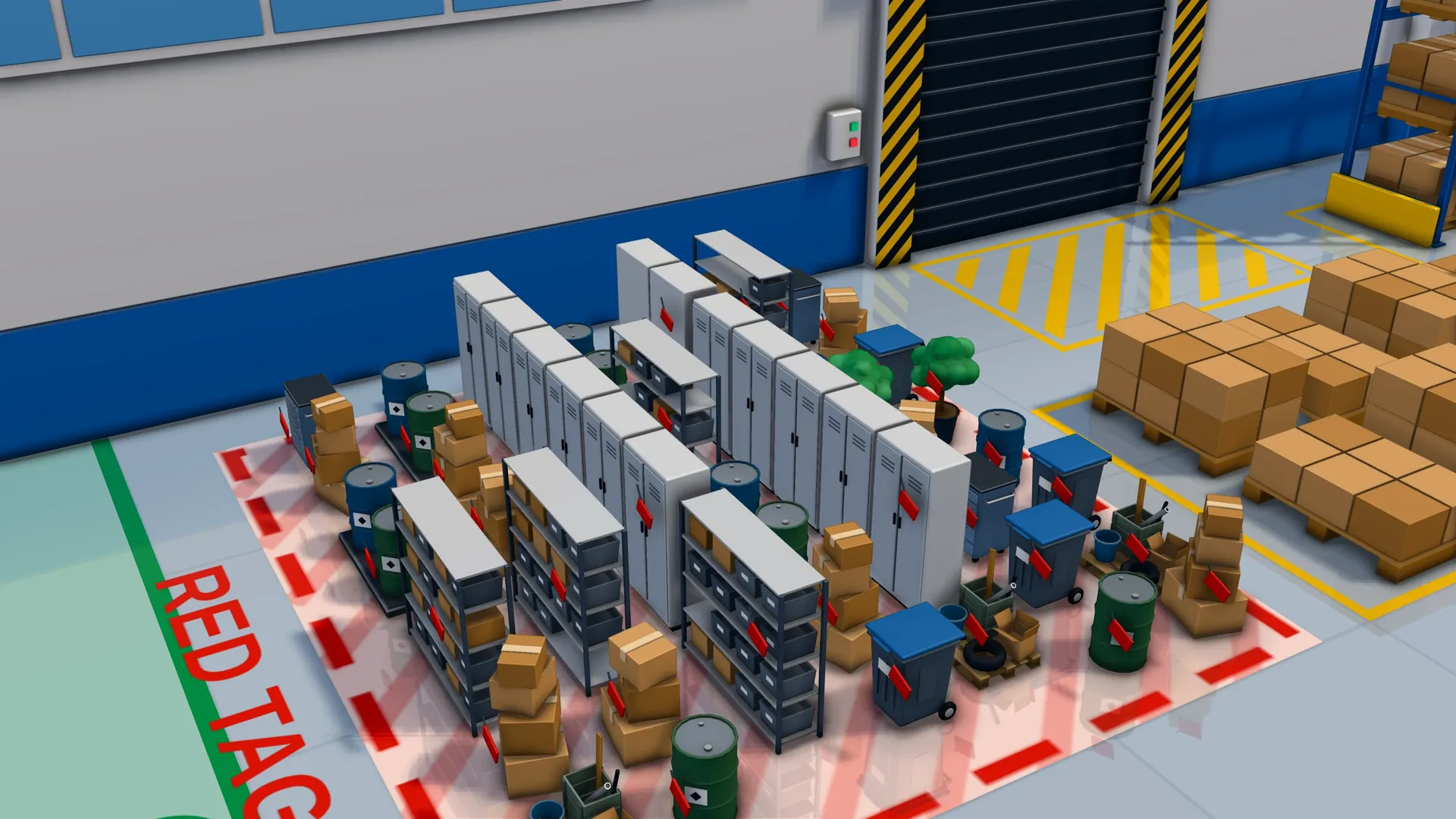
Browser · 1–20 players
LeanActivity Online Game
A 3D factory in the browser: 12 rounds, 5 shifts and 7 improvement workshops in teams of 5, led by a moderator.
See the Online Game
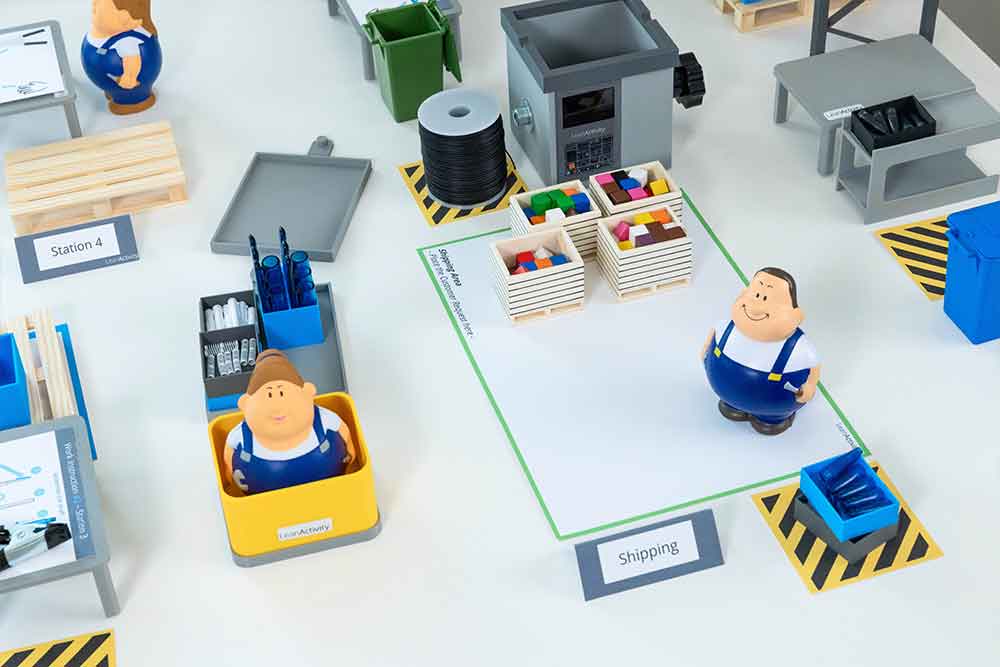
Tabletop kit · 6–16 players
LeanActivity Factory Game
The physical Lean factory on the table: figures, parts and stations for workshops in the training room.
See the Factory Game
The Online Game demo runs in the browser, no installation.
FAQ
Kaizen workshops: common questions.
What is a Kaizen workshop?
A Kaizen workshop is a short, focused session, usually half a day to two days, in which the people who do the work improve one process together. They define a measurable target, observe and time the real process, find the waste and its root causes, try the best ideas straight away and end with a new standard and an action plan.
What is the difference between a Kaizen workshop and a Kaizen event?
The terms overlap: the Lean Enterprise Institute uses Kaizen workshop, Kaizen event and Kaizen blitz for the same format. In practice, many companies call the shorter format of half a day to two days a Kaizen workshop and the classic three to five day format with equipment or layout changes a Kaizen event.
How long should a Kaizen workshop be?
Half a day is enough for one small, well-defined problem, such as the search time at one workstation. One day suits one process step, two days a whole process. If machines or layouts have to move, plan a three to five day Kaizen event instead.
Who should attend a Kaizen workshop?
Five to eight people: the people who do the work, ideally from every shift involved, one person from another area who brings fresh eyes, and a facilitator. Support functions such as maintenance, IT or quality should be on call, and the sponsor opens the workshop and joins the report-out.
What is a typical Kaizen workshop agenda?
Welcome and target, a short Lean game or input on the basics, observing the current state at the gemba, mapping the process and marking the waste, root causes, ideas and choice, trying the best ideas and measuring again, and finally the new standard, an action plan and a short report-out to the sponsor.
What do you need to prepare for a Kaizen workshop?
A problem and target in one sentence, a sponsor, a team released from normal work, support functions on call, baseline figures, a room close to the process and materials: sticky notes, markers, flip chart, brown paper, a stopwatch or phone and the current standard. Book the 30-day review before you start.
What happens after a Kaizen workshop?
The new standard is posted at the workplace and every shift is trained. Open actions get an owner and a date and are checked every week. After 30 days the team measures again against the target, reports to the sponsor and decides on the next problem.
Can you run a Kaizen workshop online?
Partly. Office and service processes can be mapped and improved in a video call with a shared whiteboard, and the kick-off can be an online Lean game. Shop-floor processes still need people at the gemba to observe, time and try the changes.
How do you make a Kaizen workshop engaging?
Start at the gemba instead of with slides, open with a short Lean game so everyone experiences waste first-hand, let people write silently before they discuss, try ideas instead of debating them and let the team, not the facilitator, present the results.