The short answer
5S is a Lean method for organising a workplace in five steps (Sort, Set in order, Shine, Standardise, Sustain), so everything needed has a fixed place and problems show at a glance. In three moves:
1Clear out
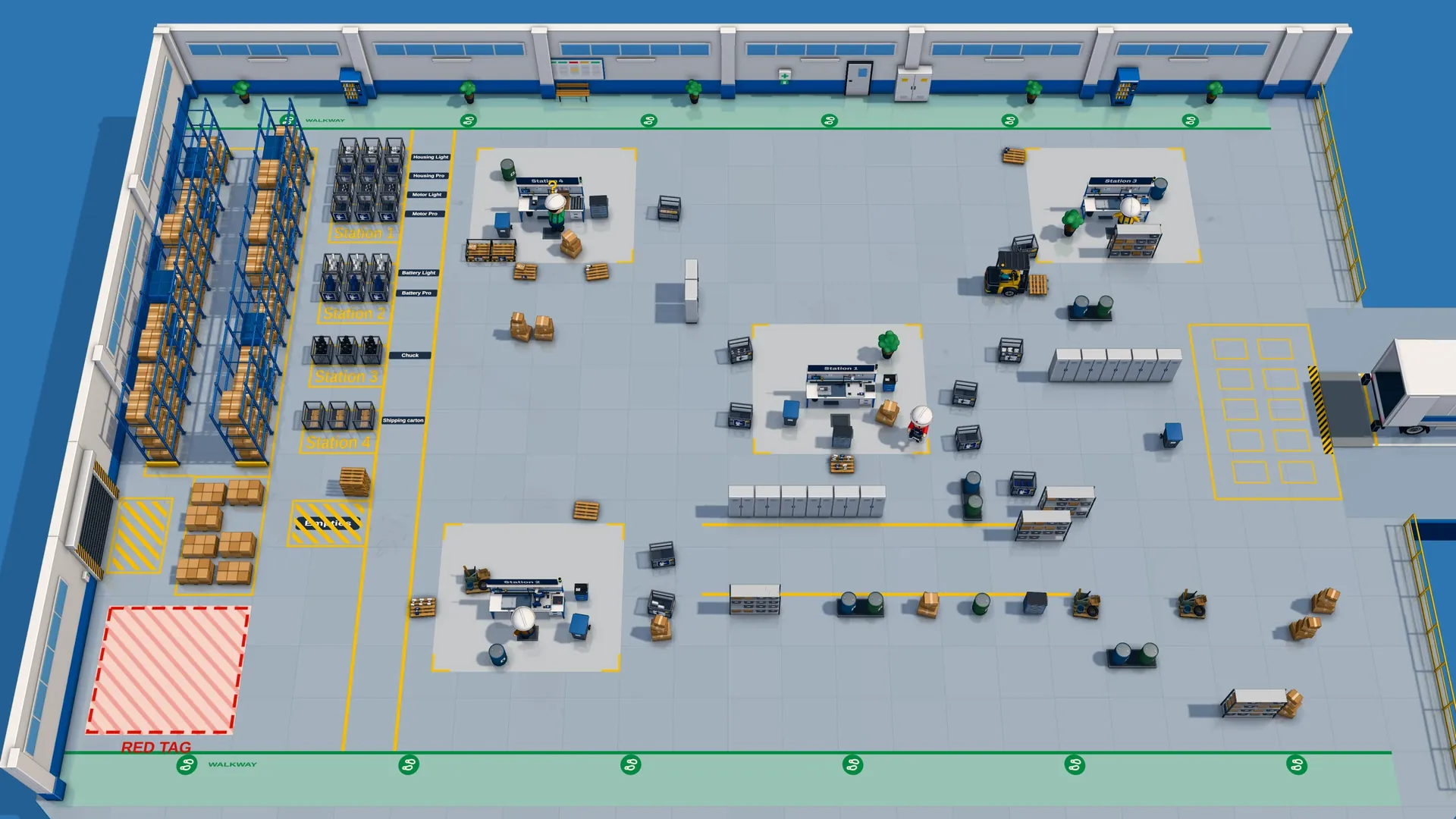
Sort: remove what the work does not need. Items nobody can decide on get a red tag and wait in a red tag area.
Step 12Organise and clean
Set in order and Shine: a marked place for everything, close to where it is used, and cleaning as inspection.
Steps 2–33Make it last
Standardise and Sustain: photo standards, short routines and a regular audit, so the area does not slide back.
Steps 4–5
Basics
What 5S means.
5S is a Lean method for organising a workplace: everything the work needs is there, in a fixed place, clean and ready, and anything that is missing or wrong shows at a glance. The name comes from five Japanese words that start with S. In English, 5S stands for Sort, Set in order, Shine, Standardise and Sustain (short definition in our Lean glossary).
The Lean Enterprise Institute describes 5S as workplace practices that support visual control and Lean production, and stresses that it is more than a one-time clean-up (Lean Lexicon, LEI).
| Japanese | What it means | English name | Also called | |
|---|---|---|---|---|
| 1 | Seiri (整理) | Separate what is needed from what is not, and remove the rest | Sort | Sift |
| 2 | Seiton (整頓) | Arrange what remains so everything has a place | Set in order | Straighten |
| 3 | Seiso (清掃) | Clean the area and the equipment | Shine | Sweep, clean |
| 4 | Seiketsu (清潔) | Keep the first three S as the normal state | Standardise | Standardize (US spelling) |
| 5 | Shitsuke (躾) | Discipline: keep doing the first four S | Sustain | Self-discipline |
5 steps
The 5 steps of 5S, with factory and office examples.
Each step has a quick check you can do on the spot, and one example from production and one from the office. Work through them in order: each S builds on the one before.
Change the workplace
Steps 1–3: Sort, Set in order, Shine
1Sort (seiri)
Remove everything the current work does not need. Ask of every item: is it needed here, how often and how many? Items nobody can decide on get a red tag and wait in a red tag area for a fixed time.
Quick check
Examples
Factory: old fixtures, a box of obsolete parts and two broken screwdrivers leave the bench; only the tools for current products stay.
Office: binders from closed projects, a printer nobody uses and five versions of the same form are archived, returned or recycled.
2Set in order (seiton)
Give every remaining item a fixed, marked place close to where it is used, in the order of use: daily items within reach, rare ones further away. A place for everything, and everything in its place.
Quick check
Examples
Factory: a shadow board at the press, floor marks for the parts trolley, labelled bins with min/max lines.
Office: labelled shelves for shared supplies and one agreed folder structure on the shared drive.
3Shine (seiso)
Clean the area and the equipment, then keep it clean with short routines. Shine is also inspection: while cleaning, people notice leaks, loose screws and wear early. Remove the sources of dirt, not just the dirt.
Quick check
Examples
Factory: a five-minute clean at the end of each shift with a checklist per machine: wipe, look, report. An oil drip is fixed before it becomes a breakdown.
Office: clear shared desks, a cleaning rota for the printer and kitchen area, empty download folders.
Keep it that way
Steps 4–5: Standardise, Sustain
4Standardise (seiketsu)
Make the first three S the normal way of working, so the result no longer depends on a clean-up day. Photos of the target state, one rule for labels and colours, short checklists and clear owners.
Quick check
Examples
Factory: a photo of the target state at each workstation, a 5S task board and the same floor colour for the same purpose in every hall.
Office: a one-page desk standard with a photo and a file naming rule such as date_project_topic_v01.
5Sustain (shitsuke)
Shitsuke literally means discipline, but in practice it is about habits, not policing: short regular audits, visible results, leaders who ask about 5S on their gemba walks and a team that keeps improving the standard.
Quick check
Examples
Factory: a ten-minute audit every week with a rotating auditor; the lowest S becomes the topic of the next team meeting.
Office: folder owners review the shared drive once a month and report in the team meeting.
Before and after
5S before and after: what really changes.
The before-and-after photo is the most persuasive part of 5S, but the real change is in the work: less searching, shorter walks, free floor space and problems that show at once. Photograph and measure both, from the same spot.
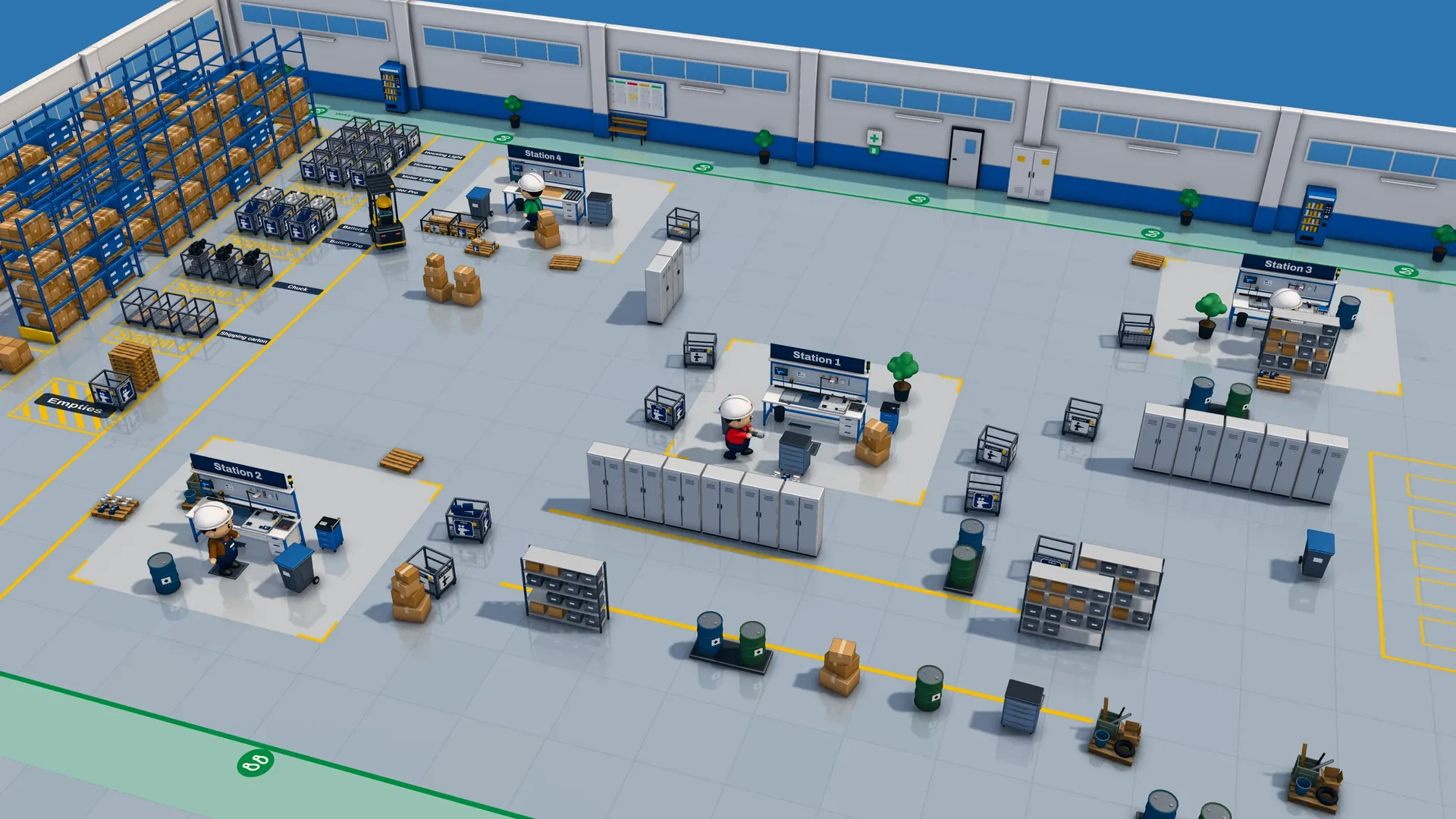 Before
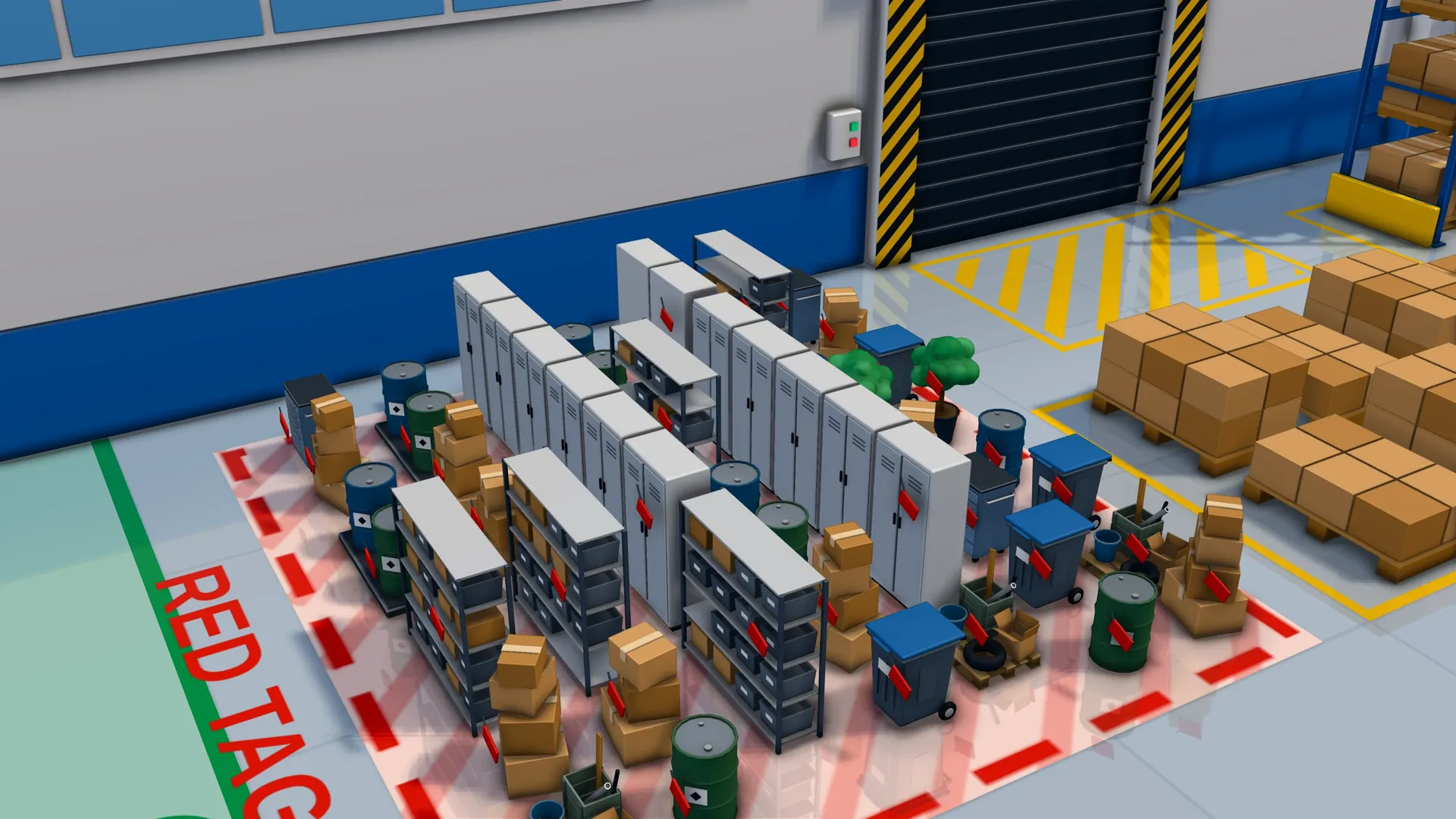 Sort
| Measure | How to measure it in 10 minutes | Example |
|---|---|---|
| Search time | Ask someone to fetch five typical tools or files and time it | 4 min before, 40 s after |
| Walking | Draw one operator’s path for one cycle on a floor plan (a spaghetti diagram) | 60 m before, 25 m after |
| Floor space | Measure the area freed by Sort | 12 m² freed |
| Items removed | Count the red tags from the Sort session | 140 red tags |
| Audit score | Use the quick audit below or the full template | 15 of 30 before, 24 of 30 after |
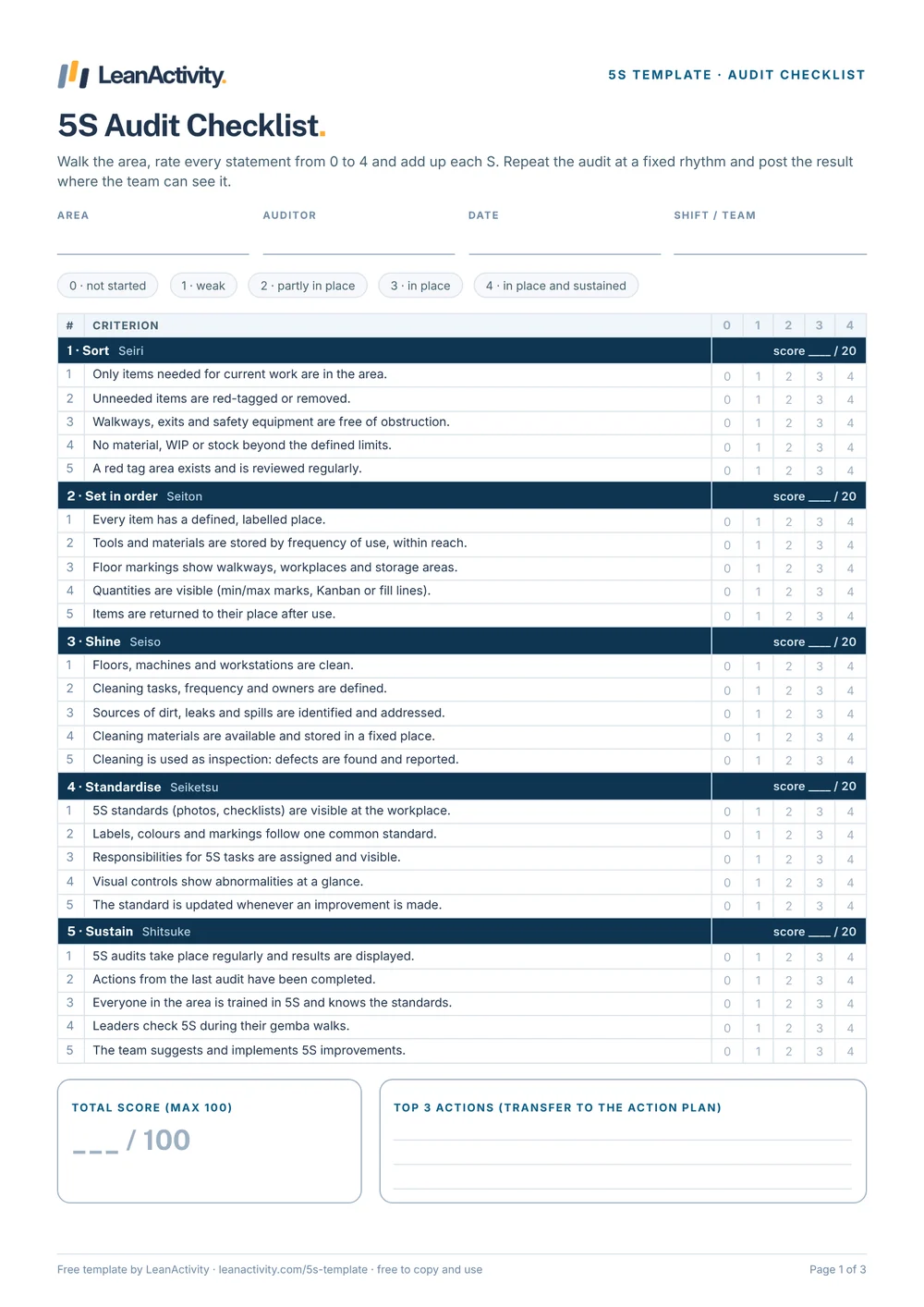
5S audit
5S quick audit: where does your area stand?.
A 5S audit checks whether an area meets its own 5S standard, often called 5S compliance. Rate three statements per S as no, partly or yes. You get a score for each S, the S to start with and a result to copy into your notes or team board.
Example answers are filled in; replace them with what you see today, not what is planned.
Your 5S score
50 %15 of 30 points
1 · Sort5 of 6
2 · Set in order4 of 6
3 · Shine3 of 6
4 · Standardise2 of 6
5 · Sustain1 of 6
On the way. The basics are there; now make them stick, starting with the weakest S.
Start here: Sustain
Fix an audit rhythm, post the result on the team board and close the actions before the next audit.
No = 0, partly = 1, yes = 2 points; 6 per S, 30 in total. The example answers show an area shortly after a first clean-up: put in your own. A quick self-check, not a full audit. Runs in your browser, nothing is sent or stored.
Floor marking
5S floor marking colours: what the tape means.
Coloured floor tape is the most visible part of Set in order: it shows where things belong, where people walk and where vehicles drive. There is no single universal 5S colour standard. Each company defines its own scheme; the table shows a widely used convention, not a regulation.
| Colour | Commonly used for |
|---|---|
| Yellow | Aisles, traffic lanes and the borders of work cells |
| White | Equipment and fixtures: workbenches, racks, carts, machines |
| Blue, green or black | Materials, work in progress and finished goods, often one colour per type |
| Orange | Material or products held for inspection |
| Red | Scrap, defects, rework and the red tag area |
| Red and white stripes | Areas to keep clear for safety, e.g. in front of fire equipment or electrical panels |
| Black and yellow stripes | Physical hazards: risk of collision, tripping or falling |
| Black and white stripes | Areas to keep clear for operational reasons |
Office
5S in the office and digital 5S.
In an office, most searching happens on screens, not in cupboards. Digital 5S applies the same five steps to shared drives, inboxes and templates. It is a good first step in a Lean office programme because everyone sees the effect within days.
| 5S step | Physical office | Digital 5S: drives, e-mail, desktop |
|---|---|---|
| Sort | Archive closed files, remove broken equipment and old forms | Archive old project folders, delete duplicates and unused templates, leave mailing lists |
| Set in order | Labelled places for shared supplies and meeting room kit | One folder structure, no more than three levels deep, and one file naming rule |
| Shine | Clear shared desks, clean the printer and kitchen area | Empty the download folder and desktop, fix broken links, close old drafts |
| Standardise | A one-page desk and meeting room standard with photos | Rules for versions, storage places and access rights; shared templates |
| Sustain | A short monthly walk-through | A named owner per folder area and a monthly review |
Safety
5S and safety: what 6S adds.
5S is a safety tool in its own right: free walkways, marked hazards and clean floors prevent trips, collisions and slips. Some practitioners add Safety as a sixth S, meaning setting up and practising safety procedures in the workshop and office (Lean Lexicon, LEI).
Whether you call it 5S or 6S matters less than asking a safety question in every step:
01
Sort
Are exits, fire extinguishers, first aid and electrical panels free of clutter?
02
Set in order
Are walkways and hazards marked, and heavy items stored low?
03
Shine
Are leaks, spills and damaged guards found and reported while cleaning?
04
Standardise
Are PPE rules and safety checks part of the posted standard?
05
Sustain
Does every audit include safety, and are near misses discussed?
Getting started
How to introduce 5S in 30 days.
Start with one pilot area that many people walk past every day, such as one cell, one store or one office zone. A visible success sells 5S better than any presentation. Then roll it out area by area.
Days 1–5
Prepare
- Choose the pilot area and name a 5S lead and a sponsor
- Explain why to the team: less searching, more safety, fewer surprises
- Photograph the area from fixed points
- Run the quick audit as a baseline
- Mark a red tag area and agree who decides, and by when
Days 6–12
Sort and set in order
- Red tag session with the whole team, all shifts
- Decide on every tagged item within the agreed time
- Arrange what remains by frequency of use
- Shadow boards, labels and floor marks, first with tape
Days 13–20
Shine and standardise
- Deep clean and list the sources of dirt and leaks
- A short cleaning routine per shift with owners
- Photo of the target state at the workplace
- One page for colours and labels, a 5S task board
Days 21–30
Sustain and review
- First weekly audit with the 5S template
- Post scores and before-and-after photos on the team board
- Leaders check 5S on their gemba walks
- Close the actions, then choose the next area
Turning the pilot into a wider programme? Our guides to the Kaizen workshop and the Kaizen event show how to run the improvement days, and the gemba walk checklist helps leaders check 5S in their daily walks.
Common mistakes
6 mistakes that make 5S fail.
A clean-up before the customer visit
5S done once for a visitor is gone a month later. It is a daily routine, not an event.
Labelling before sorting
Labels and shadow boards for things nobody needs only make the clutter permanent.
5S done to the team, not by it
When a coordinator arranges the workplace alone, nobody feels responsible for keeping it.
Standards that live in a folder
A standard nobody sees at the workplace does not exist. Post it where the work happens.
Audits without actions
A score without owners and dates turns the audit into a ritual. Fewer findings, closed every time.
Rules for the sake of rules
The Lean Enterprise Institute warns against bureaucratic 5S programmes that add rules and stifle initiative. Keep it useful.
5S is often the first step on a longer path. Once the workplace is stable, the next steps are usually quicker changeovers with SMED and the wider Lean methodology.
LeanActivity
Practise 5S in a Lean game first.
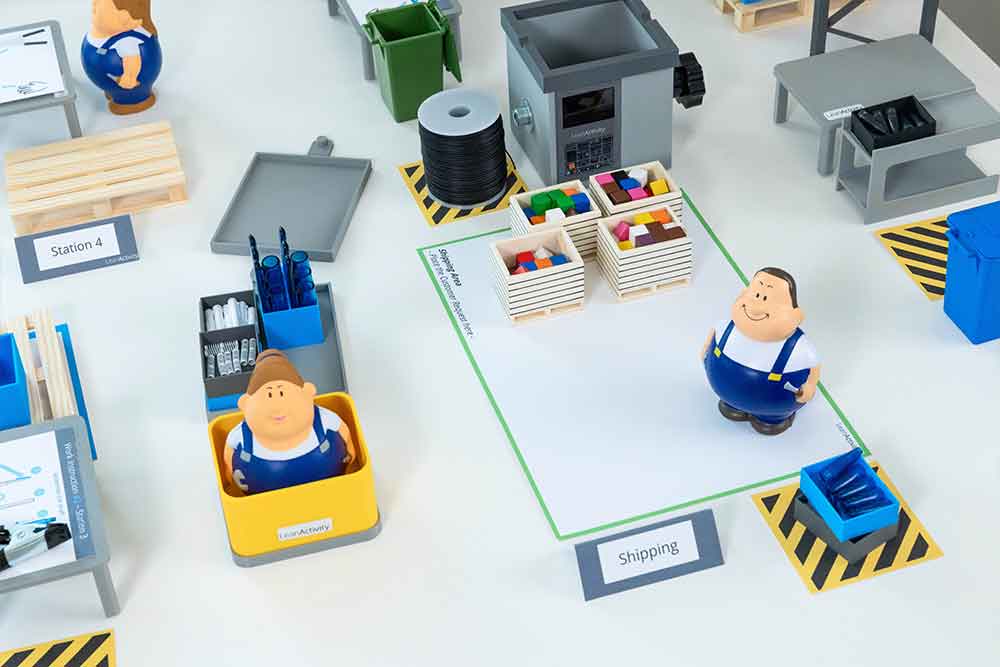
Slides can explain the five S in ten minutes, but they do not make anyone feel the search for a missing part. A Lean game does. The team works in a messy factory, feels the walking and searching, then sorts it out and sees the figures change in the next round.
In the LeanActivity Online Game, one of the seven improvement workshops is 5S with a red tag area, and the KPIs after every shift, including walking and transport, show what each change was worth. The Factory Game brings the same exercise to the training table.
Browser · 1–20 players
LeanActivity Online Game
A 3D factory in the browser: 12 rounds, 5 shifts and 7 improvement workshops in teams of 5, led by a moderator.
See the Online Game
Tabletop kit · 6–16 players
LeanActivity Factory Game
The physical Lean factory on the table: figures, parts and stations for workshops in the training room.
See the Factory Game
The Online Game demo runs in the browser, no installation.
FAQ
5S: common questions.
What is 5S and what does it stand for?
5S is a Lean method for organising a workplace in five steps: Sort, Set in order, Shine, Standardise and Sustain. It removes what is not needed, gives everything a fixed place and keeps the area clean, so that deviations show at a glance and people spend less time searching and walking.
What are the 5S in Japanese?
Seiri (sort), seiton (set in order), seiso (shine), seiketsu (standardise) and shitsuke (sustain, literally discipline). The English names also start with S. Some books use Straighten instead of Set in order.
What does standardise mean in 5S?
Standardise (seiketsu, often spelt Standardize) makes the first three steps the normal way of working instead of a one-off clean-up. Typical examples are a photo of the target state at the workplace, one rule for labels and floor colours, a short cleaning checklist and a board that shows who does which 5S task.
What is an example of 5S?
At an assembly bench, unused fixtures and broken tools go to a red tag area (Sort), the remaining tools hang on a shadow board in the order of use (Set in order), a five-minute clean ends every shift (Shine), a photo shows the target state (Standardise) and a weekly audit keeps it that way (Sustain). In an office, the same steps apply to shared cupboards and shared drives.
What do the colours of 5S floor tape mean?
There is no single universal 5S colour code; each company defines its own. A common convention is yellow for aisles and work areas, white for equipment, red for scrap and the red tag area, orange for items held for inspection, black and yellow stripes for physical hazards and red and white stripes for areas to keep clear. Legal rules in your country may set requirements for safety markings, so check them and write your scheme down in one site standard.
What is the difference between 5S and 6S?
6S adds Safety as a sixth step: setting up and practising safety procedures in the workshop and office. Whether you use 5S or 6S, the safest approach is to ask a safety question in every step, for example whether exits are free after Sort and whether leaks are reported during Shine.
How do you do a 5S audit?
Walk the area with a checklist, ideally with one person from outside the area and one from inside, and rate each criterion for every S. Add up the score per S, post the result with photos and turn the findings into actions with an owner and a date. Repeat at a fixed rhythm, for example weekly at the start and monthly once the area is stable.
Can 5S be used in an office?
Yes. In an office, 5S applies to desks, shared cupboards and meeting rooms, and above all to digital work: shared drives, inboxes and templates. Sort means archiving what nobody needs, Set in order means one folder structure and naming rule, and Sustain means a named owner and a regular review.
How long does it take to implement 5S?
A first pilot area can go through all five steps in about four weeks: a week to prepare and sort, a week to set in order, a week to clean and write the standard, and a week for the first audits. Sustaining 5S never ends, which is why the audit rhythm matters more than the launch.