The short answer
The best Lean games for training let a team feel one problem, change one thing and see the result in the next round. Here are twelve, in three groups:
1Quick warm-ups
10–30 minutes, almost no material: the coin flip game on batch size, the 5S numbers game, the multitasking name game.
Open the game finder2Workshop games
1–3 hours in rounds: paper airplanes, a building-brick factory, a paper pizza kitchen, the beer game, a pit stop changeover, error proofing.
See all 12 cards3Real work and full simulations
A waste walk or value stream walk in your own area, or a full Lean factory simulation that connects every method.
Short game or simulation
Game finder
12 Lean games for training, with a game finder.
Eleven classic exercises you can run with paper, coins or bricks, and one full simulation. Each card shows what happens, group size, time, material and the lesson; times include a short debrief. The finder runs in your browser, nothing is sent or stored.
Paper airplane factory
- Flow
- Kanban & pull
- Waste
- Quality
Teams fold paper airplanes on a small line, one fold per station, while a customer checks every plane. Round one pushes big batches; later rounds bring one-piece flow and a pull signal, and the team compares output, stock and rejects.
- Players
- 5–8 per line; lines in parallel
- Time
- 45–90 min
- Material
- A4 paper, folding instructions, a stopwatch, a flip chart
What it teaches
Push versus pull, batch size, one-piece flow, quality at the source
Coin flip game
Also called the penny game
- Flow
Four players each turn over every coin in a batch before passing it on, while timekeepers record when the first and the last coin reach the customer. Between rounds the batch shrinks from 20 to 5 to 1.
- Players
- 4 players plus timekeepers per team
- Time
- 20–30 min
- Material
- 20 coins per team, stopwatches or phones, a results table
- Online
- Coins at home, hand-overs on a shared whiteboard
What it teaches
Smaller batches shorten the lead time and deliver the first piece far sooner
5S numbers game
- 5S
- Waste
Players cross out the numbers 1 to 49, scattered among extra numbers, in order and against the clock. Between rounds the sheet gets one 5S step (the extra numbers go, the rest move into a fixed pattern) and the score climbs.
- Players
- Any number, alone or in pairs
- Time
- 15–25 min
- Material
- Four printed sheets per player, a pen, a timer
- Online
- Share the sheets on screen
What it teaches
How Sort and Set in order cut search time
Building-brick car factory
- Flow
- Kanban & pull
- Waste
Teams build small cars from building bricks to customer orders in several variants, with a parts store, four to six stations and shipping. After a chaotic first round they redesign the layout, write standard work and link the stations with kanban cards.
- Players
- 6–12 per factory
- Time
- 1.5–3 hours
- Material
- Bricks for 20–30 cars, build instructions, order and kanban cards
What it teaches
Layout, standard work, kanban and pull, several variants on one line
Paper pizza kitchen
- Kanban & pull
- Flow
- Waste
Teams run a pizza kitchen made of paper: bases, toppings cut from coloured paper, a timed oven and a customer who accepts or rejects. Between rounds they add a board, limits on work in progress and kanban signals, and waste fewer pizzas.
- Players
- 4–8 per kitchen; kitchens in parallel
- Time
- 60–90 min
- Material
- Coloured paper, scissors, glue, paper plates, order cards, sticky notes
What it teaches
Visual boards, limits on work in progress and pull signals
Beer distribution game
- Supply chain
Retailer, wholesaler, distributor and factory each order every week from the stage upstream, without talking to each other. Customer demand changes once and then stays flat, yet orders and stock swing harder at every stage up the chain.
- Players
- 4–8 per chain; chains in parallel
- Time
- 1.5–2.5 hours
- Material
- A board version with chips and order slips, or an online version
- Online
- Online versions exist, e.g. from MIT Sloan
What it teaches
The bullwhip effect: delays and missing information amplify small changes in demand
Multitasking name game
- Flow
- Waste
Players write out three names, first switching to the next name after every letter, then one name at a time, while a partner times both rounds. Switching takes longer, and every name is finished later.
- Players
- Any number, in pairs
- Time
- 10–15 min
- Material
- Paper, pens, a stopwatch per pair
- Online
- Works well in a video call
What it teaches
The cost of task switching, and why limiting work in progress helps every customer
Value stream walk with a real product
- Waste
- Flow
The group follows one real product or order backwards, from shipping to goods receipt, and notes the process time, stock and waiting at every step. Back in the room they sketch a current-state map and compare work time with lead time.
- Players
- 3–10; small groups see more
- Time
- 1.5–3 hours
- Material
- Clipboards, A3 paper, a stopwatch, safety gear, the area manager’s permission
What it teaches
Value stream thinking: lead time versus process time
Waste walk scavenger hunt
- Waste
Teams get a card with the 8 wastes and 30 to 45 minutes to photograph an example of each in a real area of the plant or office. Back in the room they show their best finds, each with one idea to remove it.
- Players
- Teams of 2–4, up to about 30
- Time
- 60–90 min
- Material
- Waste cards, phones for photos, a points board
What it teaches
Seeing the 8 wastes in your own work
Pit stop changeover
- SMED
The group analyses a motor racing pit stop on video: what does the crew prepare before the car arrives? Teams then time a changeover of their own (a toy car wheel, a printer, a machine), split internal from external steps and repeat it faster.
- Players
- Teams of 4–6
- Time
- 60–90 min
- Material
- A pit stop video, a simple changeover task, a stopwatch, an observation sheet
- Online
- Video analysis online, the changeover on site
What it teaches
SMED: move work outside the stop, prepare, work in parallel
Error-proofing challenge
- Quality
Teams assemble a simple product from parts that are easy to confuse or forget. After a round with defects they build poka-yoke aids from card and tape so the mistake cannot happen, then build again and count.
- Players
- Teams of 3–5
- Time
- 45–60 min
- Material
- Look-alike small parts, card, tape, scissors, a defect tally sheet
What it teaches
Poka-yoke: preventing an error beats finding it at the end
Full Lean factory simulation
- Flow
- 5S
- Kanban & pull
- SMED
- Waste
- Quality
A team runs a complete small factory over several rounds, starting in chaos and adding one Lean method per improvement round, from 5S to flow, line balancing and pull. Key figures after every round show what each change achieved.
- Players
- LeanActivity: 1–20 online, 6–16 on the table
- Time
- About 2 h online, 4 h on the table
- Material
- A ready-made kit or browser game, such as the three LeanActivity games
- Online
- The Online Game runs in the browser
What it teaches
The whole toolbox in one connected story
How to pick
How to pick the right Lean game.
Four questions narrow twelve games down to two or three. The full method, with formats and a session plan, is in our guide on how to choose and run a Lean game.
01
What should people learn?
One game, one lesson. Choose the lesson first, then the game, using the table below.
02
How much time do you have?
Under 30 minutes: a warm-up. One to three hours: a workshop game. Half a day: a full simulation, or two games and a waste walk.
03
Who is in the room?
Shop-floor teams like building with their hands; office teams recognise themselves in the name and pizza games. Plan one facilitator per two teams.
04
Online or on site?
Six of the twelve work online, fully or partly. The others need a table and material.
| To teach … | Play |
|---|---|
| Flow and batch size (one-piece flow) | Coin flip game, paper airplane factory, multitasking name game |
| 5S | 5S numbers game |
| Kanban and pull | Paper pizza kitchen, building-brick car factory |
| Quick changeover (SMED) | Pit stop changeover |
| The 8 wastes | Waste walk scavenger hunt, value stream walk |
| Quality (poka-yoke) | Error-proofing challenge |
| Supply chain | Beer distribution game |
| All of it, in one connected story | Full Lean factory simulation |
Full simulations
Short exercise or full simulation?.
A classic exercise teaches one principle, quickly and cheaply. A full simulation connects them: the same team improves the same factory round by round and sees how the methods build on each other. Neither is better in general; it depends on what you need.
| Classic exercise | Full Lean simulation | |
|---|---|---|
| Time | 10 minutes to 3 hours | About 2 hours online, about half a day on the table |
| Lessons | One principle per game | The whole toolbox, one method per round |
| Material and figures | Paper, coins or bricks; figures collected by hand | A ready-made kit or browser game; figures built in |
| Cost | Almost nothing | A paid kit or licence |
| Best for | Warm-ups, one topic, a refresher | Lean basics, onboarding, the kick-off of a Kaizen workshop, distributed teams |
Three full simulations from LeanActivity
We make these three, so weigh our description accordingly. If one topic is all you need, a classic exercise costs far less.
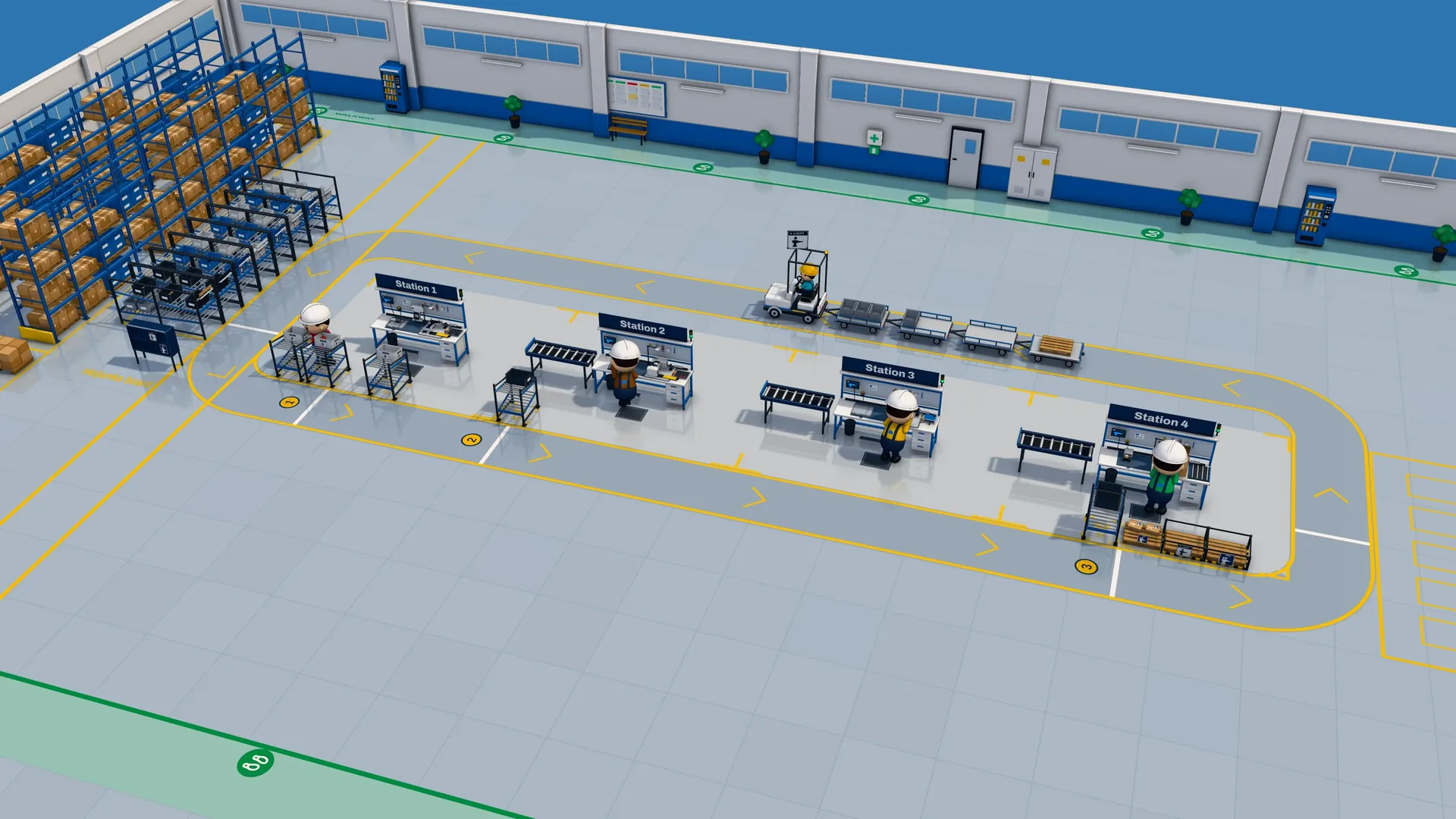
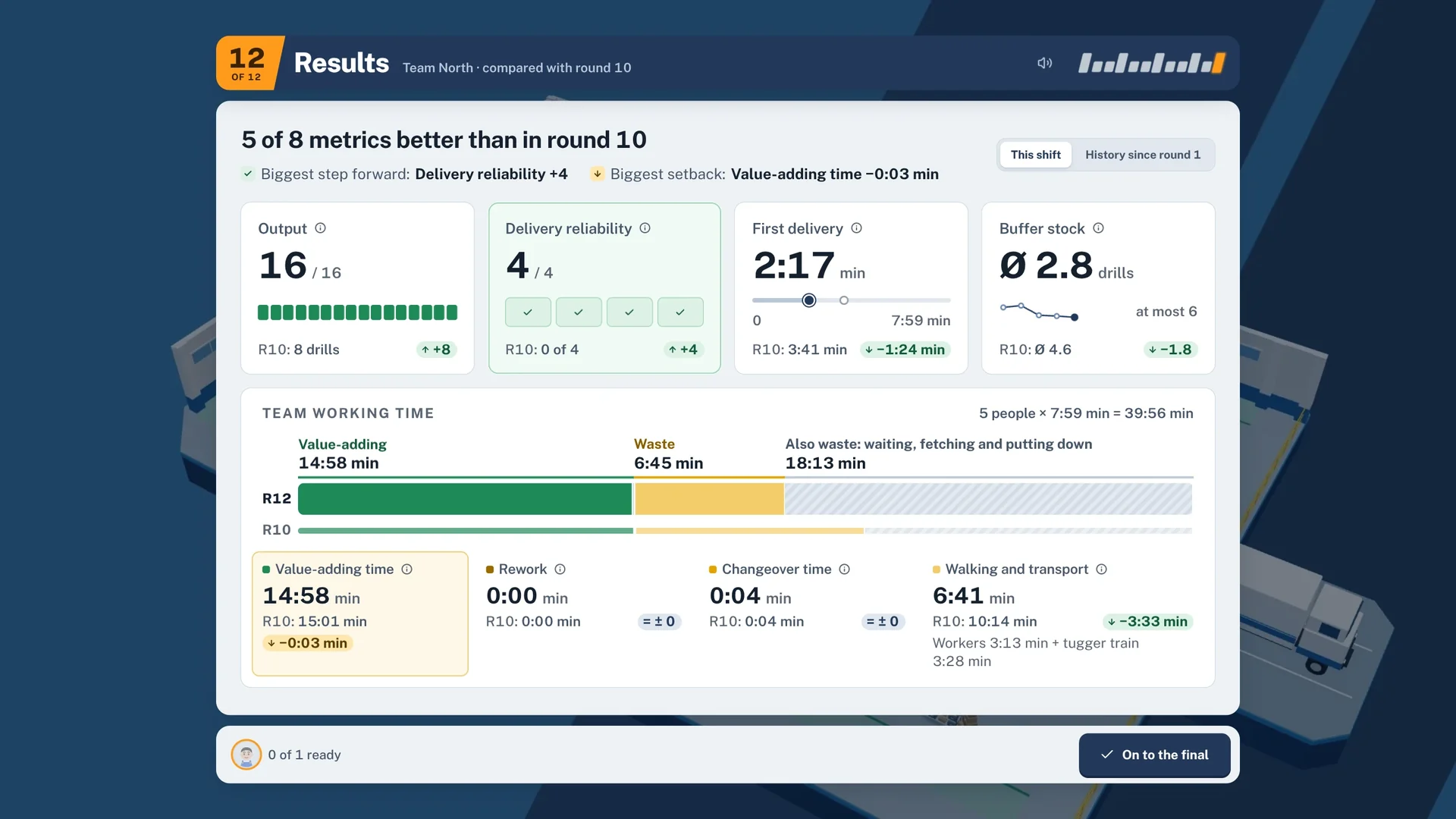
A 3D factory in the browser for 1–20 players in teams of 5; bots take free seats. 12 rounds (5 shifts, 7 improvement workshops), 8 key figures after every shift, a moderator with a live cockpit. About 2 hours.
A physical tabletop kit for 6–16 players, about 4 hours, set up in about 15 minutes. Used by more than 1,500 Lean professionals and production managers worldwide.
A physical simulation of administrative processes for 6–12 participants, about 4 hours.
Debrief
How to debrief a Lean game.
The game is the hook; the learning happens in the debrief. Ask before you explain, and plan as much time for talking as for playing. More techniques are in our guide to facilitating Lean simulations.
Questions to copy
8 debrief questions for any Lean game
Debrief: [game], round [number]
Ask first, explain later.
What happened:
1. What did you notice during the round?
2. What do the figures say: output, lead time, stock, defects?
Why it happened:
3. Where did you wait, search or redo something, and why?
4. Which of the 8 wastes did you see?
What to change:
5. Which one change would help most in the next round?
6. What do you expect the figures to do after it?
Back to real work:
7. Where do you see the same pattern in your own work?
8. What will you try this week? Who: [name], by: [date]
Workshop agenda
A one-day Lean workshop with three games.
Three games that build on each other: a quick game on batch size, a main game on flow and pull, and a waste walk that carries the lessons into your own area. For 8 to 16 people with one facilitator.
| Time | Block | What happens |
|---|---|---|
| 08:30 | Welcome and goal | The aim of the day and one question: where do we lose time today? |
| 08:45 | Game 1: coin flip game | Batches of 20, 5 and 1, then a debrief on batch size and lead time |
| 09:30 | Break | 15 minutes |
| 09:45 | Game 2: paper airplane factory | Push and batches, then one-piece flow, then a pull signal; a debrief after each round |
| 11:45 | Lunch | 45 minutes |
| 12:30 | Game 3: waste walk scavenger hunt | Teams of three photograph the 8 wastes in a real area |
| 13:45 | Show and choose | Each team presents its finds and picks one waste to tackle |
| 14:30 | Break | 15 minutes |
| 14:45 | Plan the first improvement | One small change per team, with an owner, a date and a figure to measure |
| 15:30 | Close | What we learned, what we will try, feedback; end at 16:00 |
Team building
Lean team building: fun with a point.
Lean games make good team events because cooperation is built into the rules: nobody wins alone, every station matters, and the team sees its own figures improve within an hour. Unlike a generic team event, people take something back to work.
- Mix the groupsProduction, office and management in one team. The planner who feels the operator’s waiting remembers it.
- Compete with your last roundCompare each team with its own first round, not with the others. Improvement keeps the mood positive.
- Talk about the process, not peopleBeer game players tend to think badly of the other stages. MIT Sloan notes how such often erroneous attributions can erode trust in any organisation (MIT Sloan); the debrief turns that into a lesson about systems.
- Celebrate the before and afterA photo of round 1 next to the last round, and the figures on a flip chart.
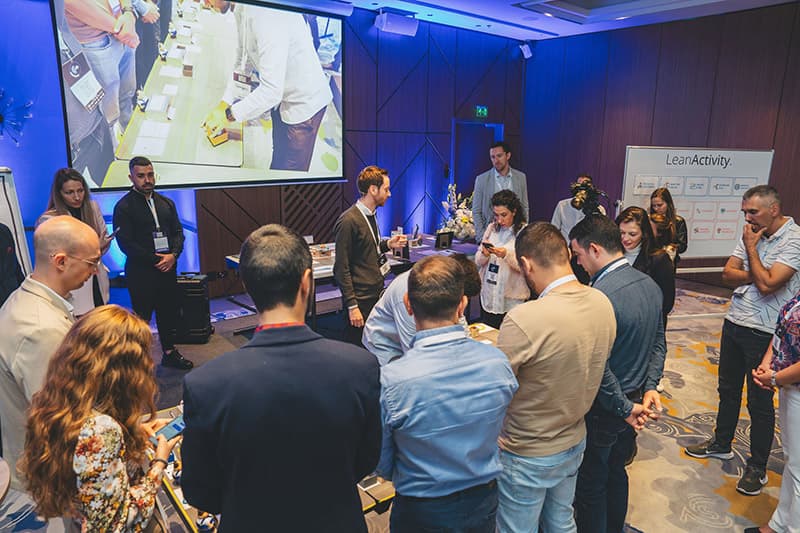
Best picks for a team event: the coin flip game as an icebreaker, then the paper airplane factory, the paper pizza kitchen or the pit stop changeover.
Online
Lean games online: what works remotely.
Not every classic survives the video call. Hand-offs of physical parts lose their feel; observing, timing and discussing travel well.
Works well online
The 5S numbers game on screen, the multitasking name game, the coin flip game with a shared whiteboard.
Online versions exist
The beer distribution game: MIT Sloan offers one for remote, in-person and hybrid sessions (MIT Sloan).
Needs a room
Paper airplanes, bricks, paper pizzas, error proofing and both walks. The pit stop is half and half: video online, changeover on site.
A Lean simulator in the browser
In the LeanActivity Online Game every player is an avatar in a 3D factory, led by a moderator.
Keep cameras on, give every breakout room a co-facilitator, test every link the day before and keep rounds shorter than in the room.
LeanActivity
Why a game beats another slide deck.
Slides explain waste; a game lets people feel it. After a chaotic first round nobody needs to be told that searching and waiting cost time: they have just done it, and the figures show it.
The LeanActivity simulations do that for the whole Lean toolbox, round by round, in the browser or on the table.
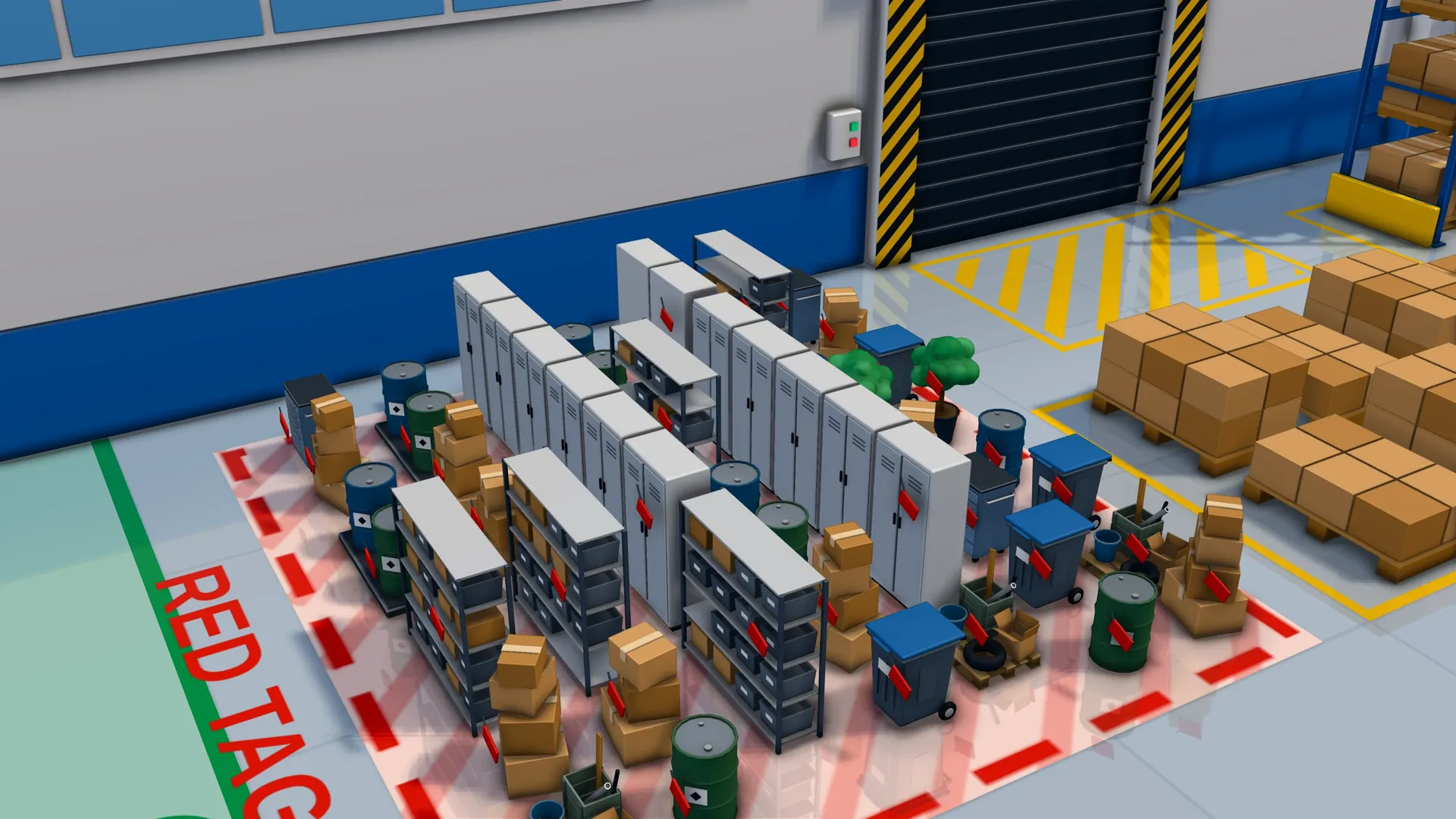
Browser · 1–20 players
LeanActivity Online Game
A 3D factory in the browser: 12 rounds, 5 shifts and 7 improvement workshops in teams of 5, led by a moderator.
See the Online Game
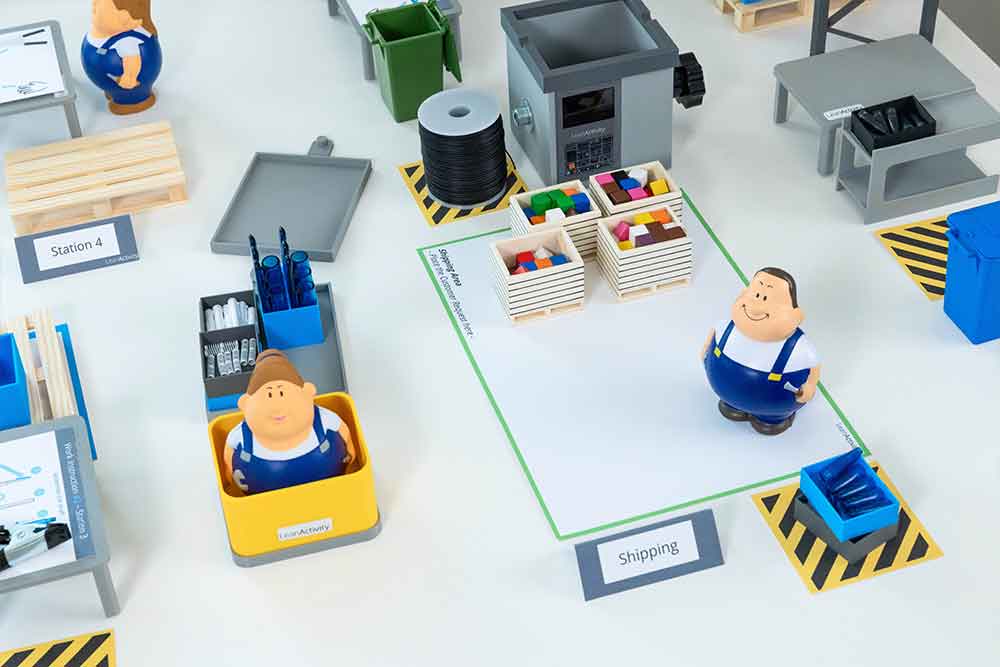
Tabletop kit · 6–16 players
LeanActivity Factory Game
The physical Lean factory on the table: figures, parts and stations for workshops in the training room.
See the Factory Game
The Online Game demo runs in the browser, no installation.
FAQ
Lean training games: common questions.
What are Lean games for training?
Lean games are short, hands-on exercises or simulations in which a team runs a small process, measures it, changes one thing and plays again. They make flow, pull, 5S and waste tangible, because people feel the problem before anyone explains the method.
What is the best Lean game for beginners?
For a first taste, the coin flip game (penny game) or the 5S numbers game: both take under 30 minutes and need almost no material. For a first workshop, the paper airplane factory; for a complete introduction, a full Lean simulation.
What is the penny game in Lean?
In the penny game, also called the coin flip game, a line of players turns over every coin in a batch before passing it on, while timekeepers record when the first and last coins reach the customer. Playing with smaller and smaller batches shows how batch size drives lead time.
What is a good Lean team building activity?
A game in which everyone has a role and the team sees its own improvement: the coin flip game, the paper airplane factory, a paper pizza kitchen or a pit stop changeover. Mix departments in each team and compare each team with its own first round, not with the others.
Can you play Lean games online?
Yes. The 5S numbers game, the multitasking name game, the coin flip game with a shared whiteboard and online versions of the beer distribution game all work in a video call. For a full simulation, the LeanActivity Online Game puts up to 20 players in a 3D factory in the browser.
What is a serious game in Lean management?
A serious game is designed to teach rather than to entertain. In Lean management it usually means a production or office simulation played in rounds: the team experiences waste, improves the process with Lean methods and sees the effect in key figures.
Which Lean game teaches the bullwhip effect?
The beer distribution game. Four stages of a supply chain order from each other without talking, and although customer demand changes only once, orders and stock swing harder at every stage upstream. MIT Sloan’s System Dynamics Group developed it in the early 1960s.
How long should a Lean training game take?
A warm-up takes 10 to 30 minutes, a workshop game with several rounds one to three hours, and a full Lean simulation about two hours online or about half a day on the table. Plan as much time for the debriefs as for playing.