The short answer
The 8 wastes of Lean (TIMWOODS) are transport, inventory, motion, waiting, overproduction, overprocessing, defects and unused skills: activities that cost time and money but add nothing the customer pays for.
1Know the eight
Seven come from Taiichi Ohno and the Toyota Production System; the eighth, unused skills, was added later.
The 8 wastes with examples2See them where work happens
A waste walk of 30 to 45 minutes shows which waste dominates in your area, not in a textbook.
Run a waste walk3Remove the biggest first
Find the root cause, then use the matching tool: 5S for searching, SMED for big batches, line balancing for waiting.
Step by step
Basics
What waste means in Lean.
In Lean, waste, in Japanese muda, is any activity that consumes resources but creates no value for the customer (Lean Lexicon, LEI).
Value is judged by the customer, not by the department doing the work. Every step falls into one of three groups.
Keep it
Value-adding
Changes the product in a way the customer wants and would pay for: assembling, machining, painting.
Example: Screwing the motor into the housing.
Reduce it
Necessary non-value-adding
Adds no value but cannot be avoided today, for example because of a law or current technology. The Lean Lexicon calls this type one muda; its example is inspecting welds for safety.
Example: A legally required final test.
Remove it
Pure waste
Adds no value and could stop now: the Lexicon’s type two muda. Most of what a waste walk finds belongs here.
Example: Walking to fetch parts, waiting, rework.
The three-question test
Ask these three questions about any step:
- 1Would the customer value the product less if this step were left out? This is the Lean Lexicon’s simple test for value (LEI).
- 2Does the step change the product or the information: its form, fit or function?
- 3Is it done right the first time?
Origin
From 7 wastes to 8: where TIMWOODS comes from.
The wastes come from the Toyota Production System. Toyota describes it as the complete elimination of waste in pursuit of the most efficient methods, and credits Taiichi Ohno with helping to establish it (Toyota Motor Corporation). Ohno grouped the waste typically found in mass production into seven categories (Lean Lexicon, LEI).
As Lean spread beyond the factory and around the world, an eighth waste was added: non-utilised talent (The Lean Post, LEI, 2020). TIMWOODS is one memory aid for the eight; DOWNTIME is another for the same list.
| TIMWOODS | Ohno’s term (Lean Lexicon) | In plain words |
|---|---|---|
| T · Transport | Conveyance | Moving material more than needed |
| I · Inventory | Inventory | More stock than the next step needs |
| M · Motion | Motion | People walking, reaching, bending, searching |
| W · Waiting | Waiting | People or machines standing still |
| O · Overproduction | Overproduction | Making more, or earlier, than needed |
| O · Overprocessing | Processing | More work than the customer values |
| D · Defects | Correction | Rework, scrap and corrections |
| S · Skills | Added later | Talent and ideas that go unused |
TIMWOODS
The 8 wastes of Lean, with examples.
Each card: a definition, an example from production and one from the office, the typical cause, the first countermeasure and a quick check for this week. For office processes in depth, see our guide to Lean office.
T · I · M · W
Transport, inventory, motion, waiting
TTransport
Moving material or products more often or further than needed. Every move costs time and risks damage.
- Typical cause
- A layout that grew over the years, central stores, departments grouped by function.
- First countermeasure
- Put the stations close together in flow order and store parts where they are used. The aim is one-piece flow.
Quick check
Examples
Production: A forklift takes parts from goods receipt to a central store, then back across the hall to the line.
Office: A request is forwarded three times before anyone works on it.
IInventory
More material, work in progress or finished goods than the next step needs. Stock ties up cash and space, and hides problems.
- Typical cause
- Big batches, long changeovers, unreliable machines or suppliers, buffers kept “just in case”.
- First countermeasure
- Limit the buffer between two steps with a marked space or a kanban, and cut batch sizes step by step.
Quick check
Examples
Production: Full pallets between stations; parts wait days for steps that take minutes.
Office: Open tickets, a full inbox, invoices waiting for the weekly approval round.
MMotion
People walking, reaching, bending or searching without adding value. Transport moves the product; motion moves the person.
- Typical cause
- No fixed place for tools and material, poorly designed workstations, shared equipment far away.
- First countermeasure
- 5S: a fixed, labelled place for everything, at the point of use and within reach.
Quick check
Examples
Production: An operator walks to a shared tool cabinet several times a shift.
Office: Searching shared drives for the current version of a file.
WWaiting
People, machines or material standing still, waiting for parts, information, an approval or a repair.
- Typical cause
- Unbalanced workloads, breakdowns, long changeovers, missing material, approvals in sequence.
- First countermeasure
- Spread the work evenly across the stations with line balancing and make stoppages visible, for example with an andon.
Quick check
Examples
Production: Station 3 waits for the slower station 2.
Office: A purchase request waits days for a signature.
O · O · D · S
Overproduction, overprocessing, defects, skills
OOverproduction
Producing more, sooner or faster than the next process or the customer needs. Taiichi Ohno considered it the most serious waste, because it generates and hides others such as inventory, defects and extra transport (Lean Lexicon, LEI).
- Typical cause
- Long changeovers, output targets, production pushed by forecasts, keeping everyone busy.
- First countermeasure
- Produce to real demand in smaller batches, and shorten changeovers with SMED so small batches pay off.
Quick check
Examples
Production: A week of one variant is made to avoid a changeover, while the other runs out.
Office: A monthly report nobody reads; documents printed “just in case”.
OOverprocessing
More work or a higher standard than the customer asks for.
- Typical cause
- Unclear customer requirements, old standards nobody questions.
- First countermeasure
- Ask the customer, internal or external, what they need, then write the leaner way down as standard work.
Quick check
Examples
Production: Polishing a hidden surface; a tolerance tighter than the function needs.
Office: Typing the same data into two systems; four signatures for a small purchase.
DDefects
Scrap, rework, corrections and the inspection needed to find them. A defect costs material and time twice.
- Typical cause
- Unclear standards, processes that allow mistakes, problems found late.
Quick check
Examples
Production: A missing screw is found at the final test; the unit goes to rework or scrap.
Office: An invoice without a purchase order number goes back to the supplier.
SSkills (unused talent)
Not using the knowledge, ideas and abilities of the people who do the work: the waste added last.
- Typical cause
- Top-down decisions, no time or process for ideas, fear of blame.
- First countermeasure
- Involve the team: ideas at the daily board, regular Kaizen workshops and an idea process with quick decisions.
Quick check
Examples
Production: Operators know why the machine jams, but nobody asks them.
Office: A specialist spends hours on data entry; ideas from the team disappear in an inbox.
Muda, mura, muri
Muda, mura and muri: waste, unevenness, overburden.
The 8 wastes are muda. Toyota names two more things to eliminate alongside it, inconsistencies and unreasonable requirements, known as mura and muri (Toyota). They often cause the waste you see on the floor.
MudaWaste
Any activity that consumes resources without creating value for the customer: the eight wastes.
Example: Walking to fetch parts, a full pallet between two stations.
MuraUnevenness
Volume, mix or workload that swing up and down. The countermeasure is levelling, known as heijunka.
Example: Most orders arrive at the end of the month: the line idles in week one and works overtime in week four.
MuriOverburden
People or equipment pushed beyond what they can sustain: too fast, too heavy, too long. Countermeasures: realistic capacity, ergonomic workstations, standard work.
Example: Lifting heavy boxes from the floor all shift; a machine run above its design speed.
Waste walk
How to run a waste walk.
A waste walk is a short, structured walk through one area to see the eight wastes where they happen, at the gemba. Plan 30 to 45 minutes; you need a small team, the checklist below and a way to count.
- 1Pick one area and one focusOne line, cell or office process, and one focus, such as “follow one order”.
- 2Bring fresh eyesTwo to four people, one from another area. Tell the team there why you are coming.
- 3Stand, watch, followFollow the product, then one person for ten minutes. Then stand still and watch.
- 4Count every wasteOne tick per observation, plus the best example. Photos only with permission.
- 5Ask, don’t judgeAsk what slows people down. You are looking at the process, not grading people.
- 6Rank and act the same dayTop one to three problems, each with an owner and a date. Tell the area team what happens next.
Checklist to copy
Waste walk checklist
Waste walk: [area], [date]
Team: [names] · Time: [30–45 minutes]
Focus: [one product, one order or one question]
Before:
Area lead informed, safety rules and PPE agreed
Floor plan, pen, tally (phone), camera only with permission
Each person watches one or two wastes in particular
During (stand, watch, ask):
Transport: how far does the part travel, how often is it moved?
Inventory: where does material pile up between steps?
Motion: where do people walk, reach, bend or search?
Waiting: when does a person or machine stand still, and why?
Overproduction: what is made before anyone needs it?
Overprocessing: which steps would the customer not miss?
Defects: where are rework, scrap or corrections?
Skills: what would the operators change if they could?
After (the same day):
Count the observations per waste and rank them
Choose the top 1–3 problems, each with an owner and a date: [owner, date]
Thank the area team and tell them what happens next
Next waste walk booked: [date]
Tool
Waste walk tally: count, rank, copy.
Use it on your phone during the walk: tap + for every waste you see and note the best example. You get a ranking and a summary to paste into an e-mail or a ticket. It runs in your browser; nothing is sent or stored.
Your ranking
Assembly line 2
25
observations
- 1Motion7 · 28 %
Operators walk to the shared screw shelf
- 2Waiting5 · 20 %
Station 3 waits for station 2
- 3Inventory4 · 16 %
Full crates between stations 1 and 2
- 4Transport3 · 12 %
- 5Overproduction2 · 8 %
- 6Defects2 · 8 %
- 7Overprocessing1 · 4 %
- 8Skills1 · 4 %
Start with motion: give every tool and part a fixed, labelled place within reach.
5S guideA count shows where waste appears most often, not what it costs: check the top items with the team before you act. The example values are illustrations. Runs in your browser; nothing is sent or stored.
Step by step
How to remove waste, step by step.
Seeing waste is the easy part. Removing it for good follows the same cycle every time, ideally in a short Kaizen workshop with the people who do the work.
01
Make it visible
A waste walk, the tally and two times: total lead time and actual work time.
02
Choose the biggest one
With the team, not for them. One problem solved beats eight half-solved.
03
Find the root cause
Ask why until you reach a cause you can change (5 Whys). Waiting is a symptom; an unbalanced line is a cause.
04
Apply the matching tool
Pick it from the table below and try it at once, in small PDCA steps.
05
Standardise and show it
Write the new way down and make the status visible with visual management, so any slip shows at once.
06
Measure, then repeat
Compare with the start, keep what works, pick the next waste. That loop is continuous improvement.
| Waste | Lean tools that remove it | Read more |
|---|---|---|
| Transport | Layout in flow order, parts stored at the point of use, a route train on a fixed loop | One-piece flow |
| Inventory | Kanban, a supermarket, smaller batches | Kanban |
| Motion | 5S, a red tag area, workstations designed for the job | 5S guide |
| Waiting | Line balancing to the takt time, andon | Line balancing |
| Overproduction | Pull, takt time, quick changeovers | SMED guide |
| Overprocessing | Clear customer requirements, standard work | Standard work |
| Defects | Poka-yoke, stop and fix at the source, root cause analysis | 5 Whys |
| Skills | Kaizen workshops, idea management, team boards | Idea management |
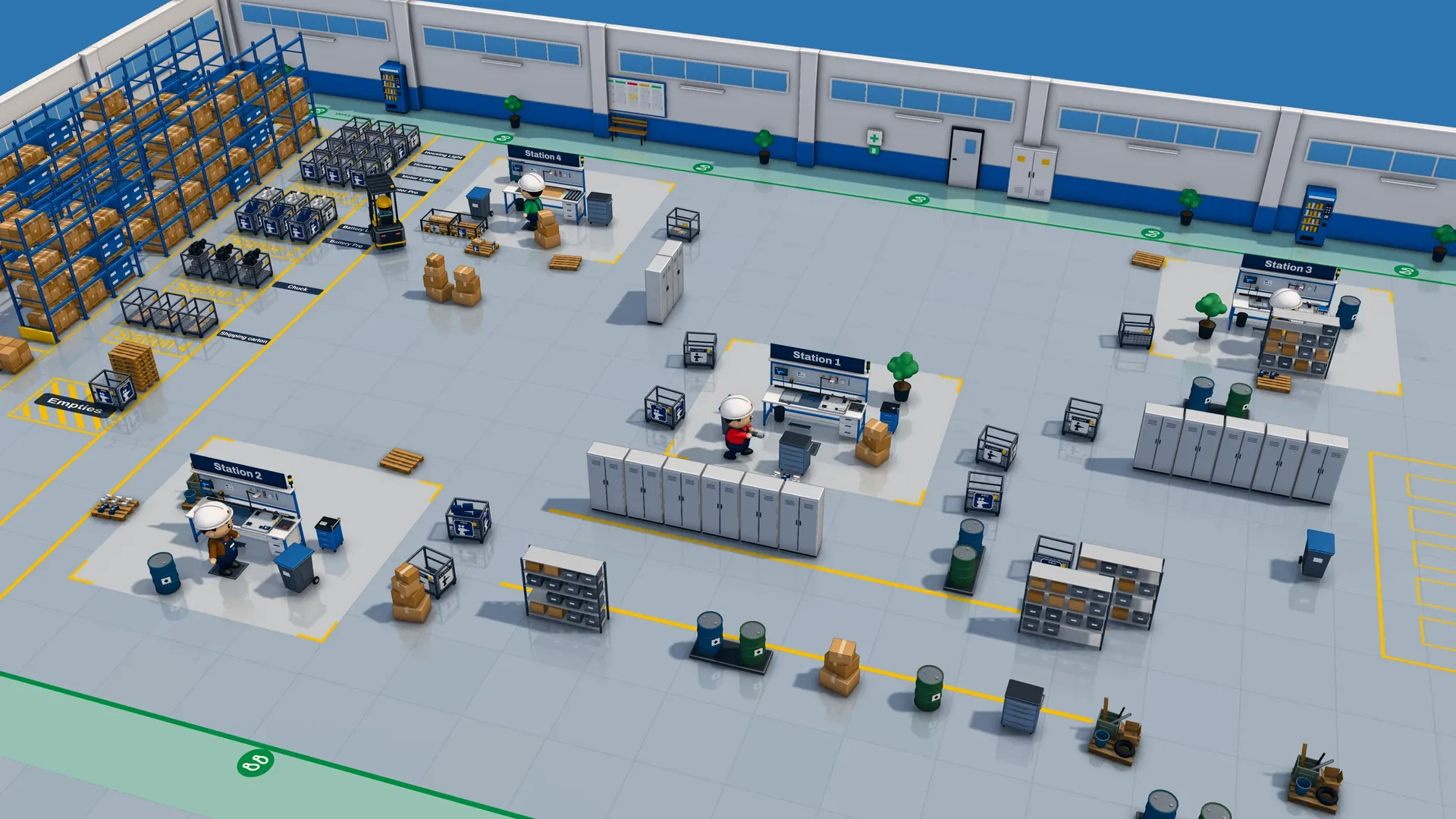
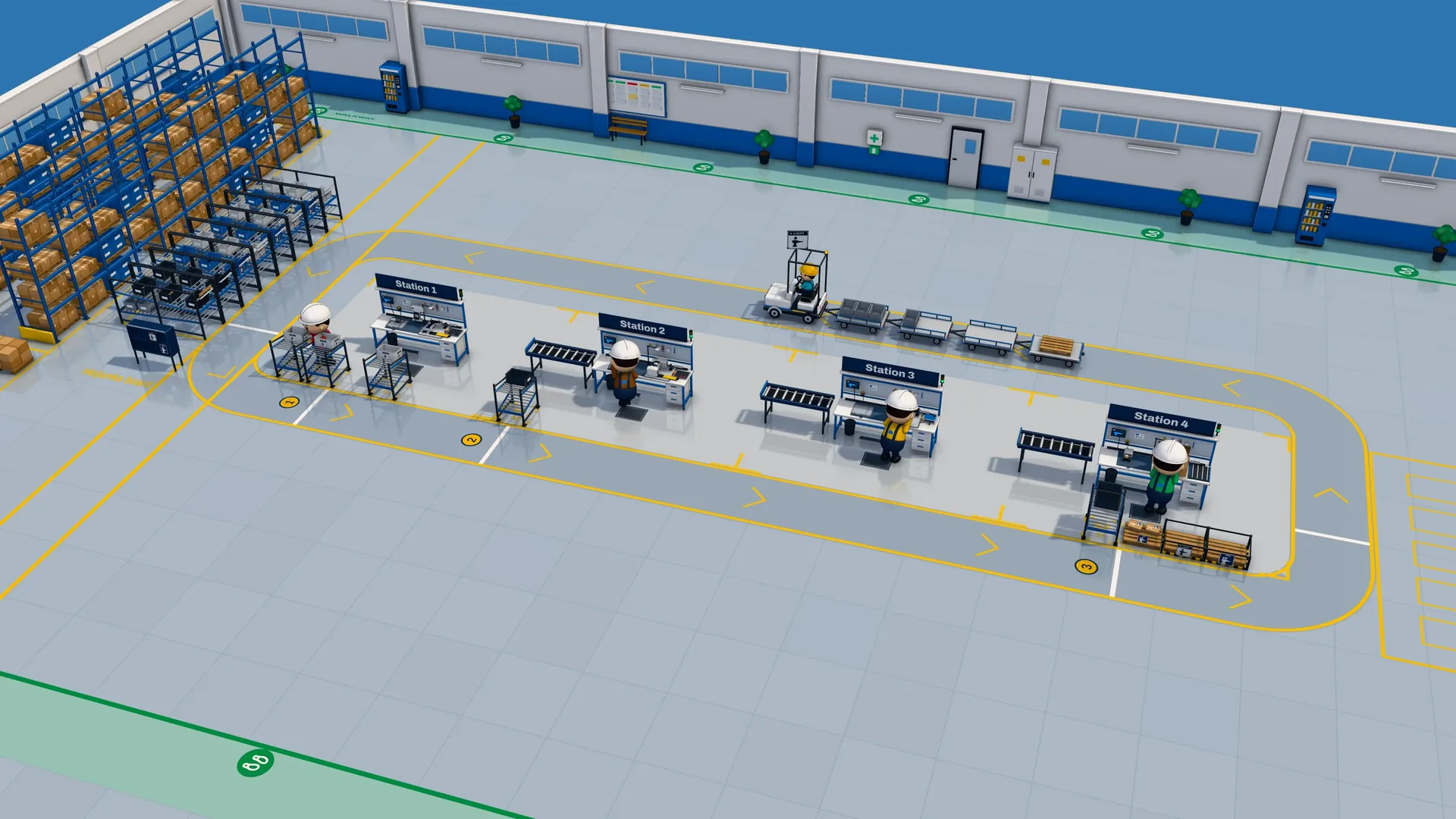
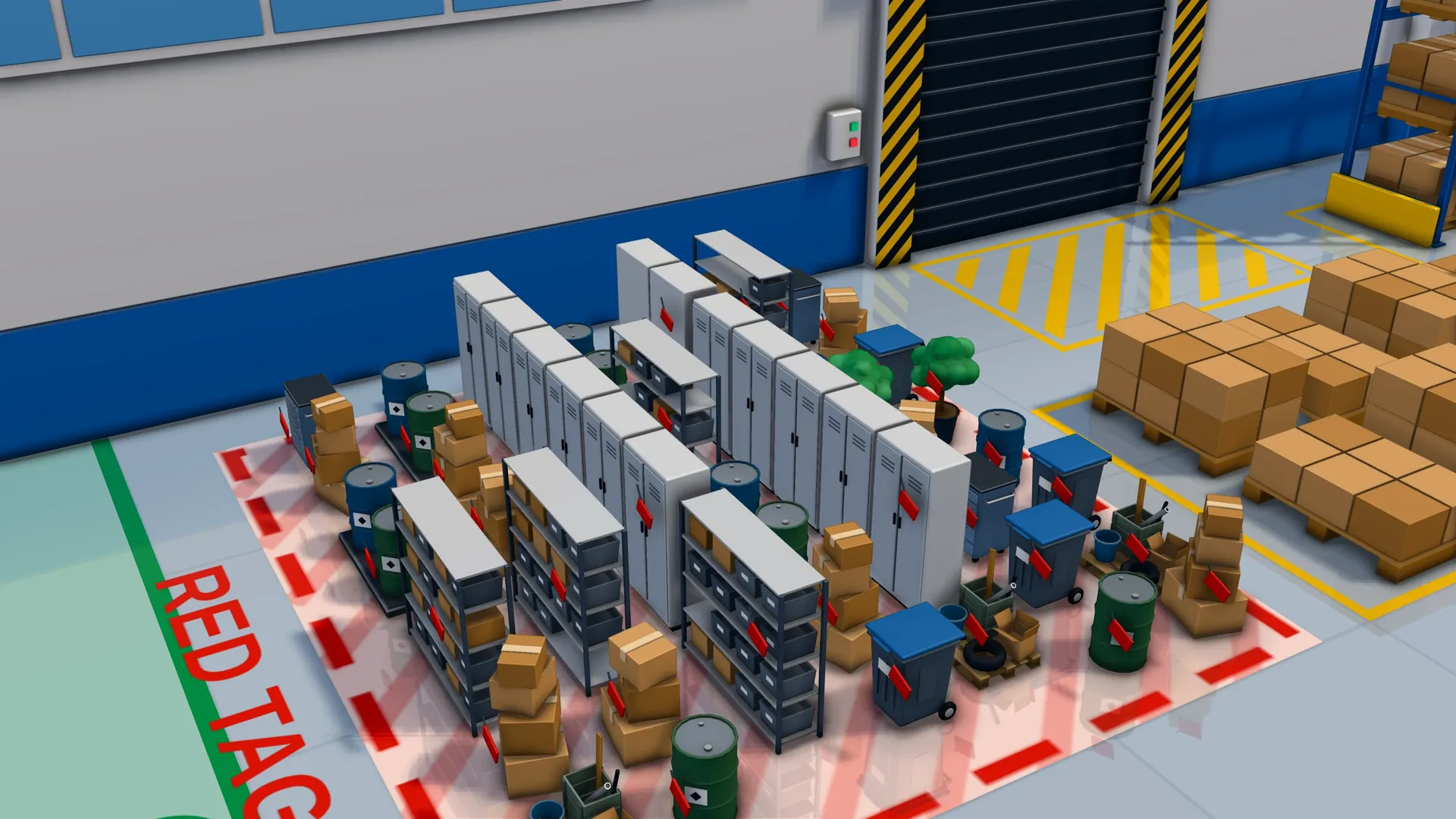
The same factory hall in the LeanActivity Online Game, before and after the improvement workshops.
Common mistakes
6 mistakes when hunting waste.
Blaming people
Waste is built into the process: layouts, batch sizes, rules. People who feel judged hide problems.
Chasing all eight at once
Sixty observations without a priority change nothing. Fix the biggest waste, then the next.
Deleting necessary work
A legally required test or a safety check has to stay. Make it faster and simpler; do not drop it.
Cutting stock before the causes
Buffers often cover long changeovers, breakdowns or unreliable supply. Remove them first and the line stops; fix the cause first and they can shrink.
Keeping everyone busy
Producing ahead so nobody waits turns waiting into overproduction, the waste that hides the others.
Walking once
Waste grows back. A short waste walk every month keeps the eyes trained.
Want the bigger picture? See where the eight wastes fit into Lean methodology, or look up any term in the Lean glossary.
LeanActivity
Feel the waste before you hunt it.
Reading about waiting is one thing; feeling it is another. In the first shifts of the LeanActivity Online Game, players run a chaotic 3D factory: they wait for parts, walk across the hall and search for the right material, while a forklift supplies the stations.
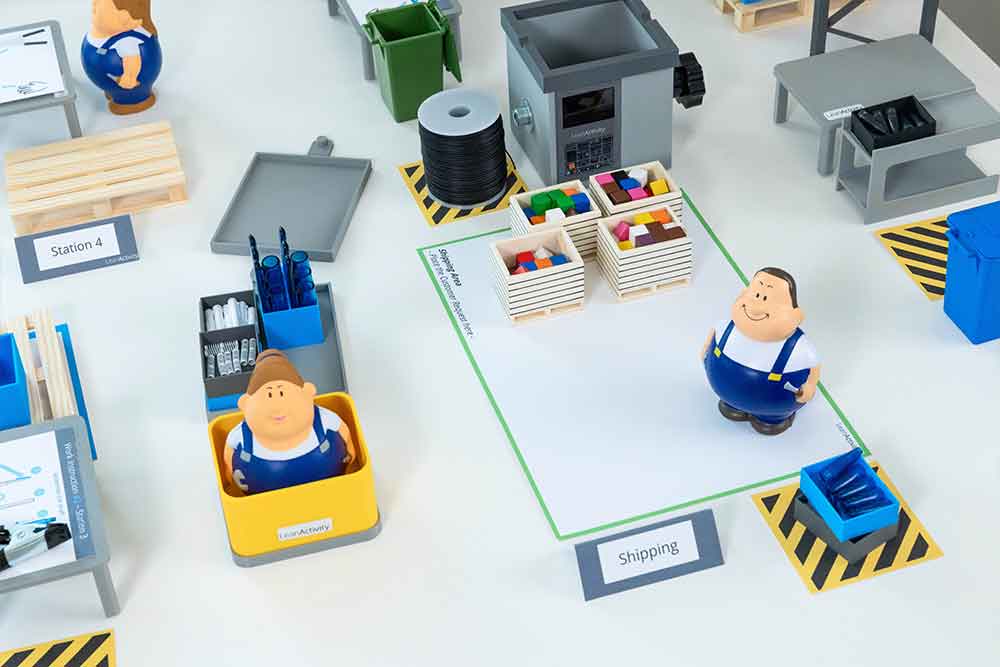
After every shift, eight KPIs, among them value-adding time, buffer stock, rework, and walking and transport, show what the waste costs. Then the team removes it in workshops such as 5S with a red tag area, Lean layout and SMED, and sees the effect in the next shift. For the training room, the tabletop Factory Game makes the same principles tangible for 6 to 16 players.
Browser · 1–20 players
LeanActivity Online Game
A 3D factory in the browser: 12 rounds, 5 shifts and 7 improvement workshops in teams of 5, led by a moderator.
See the Online Game
Tabletop kit · 6–16 players
LeanActivity Factory Game
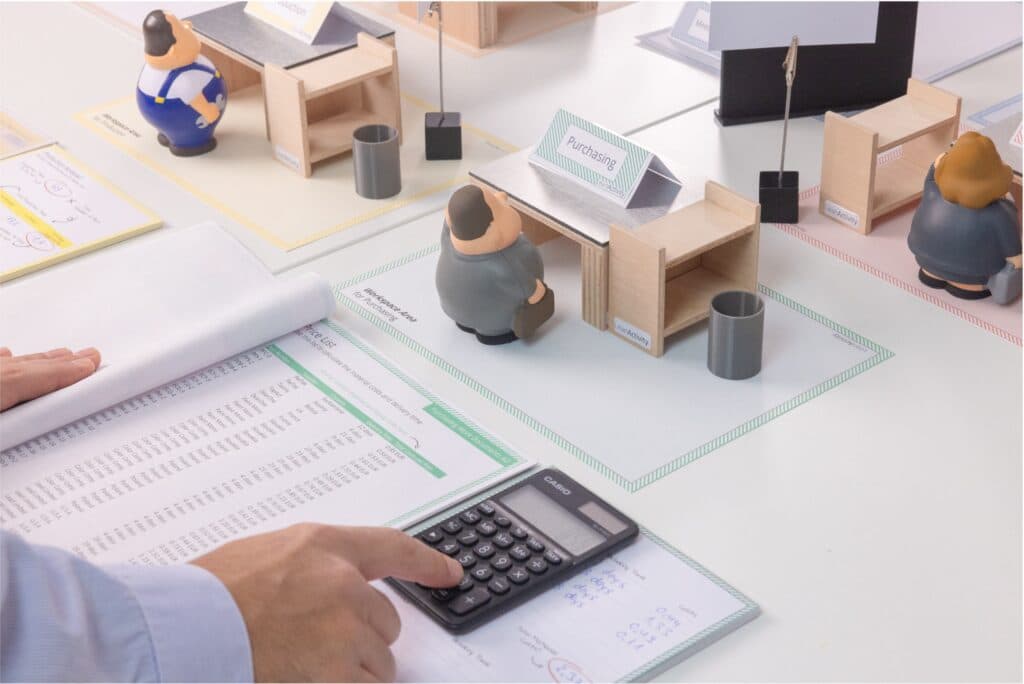
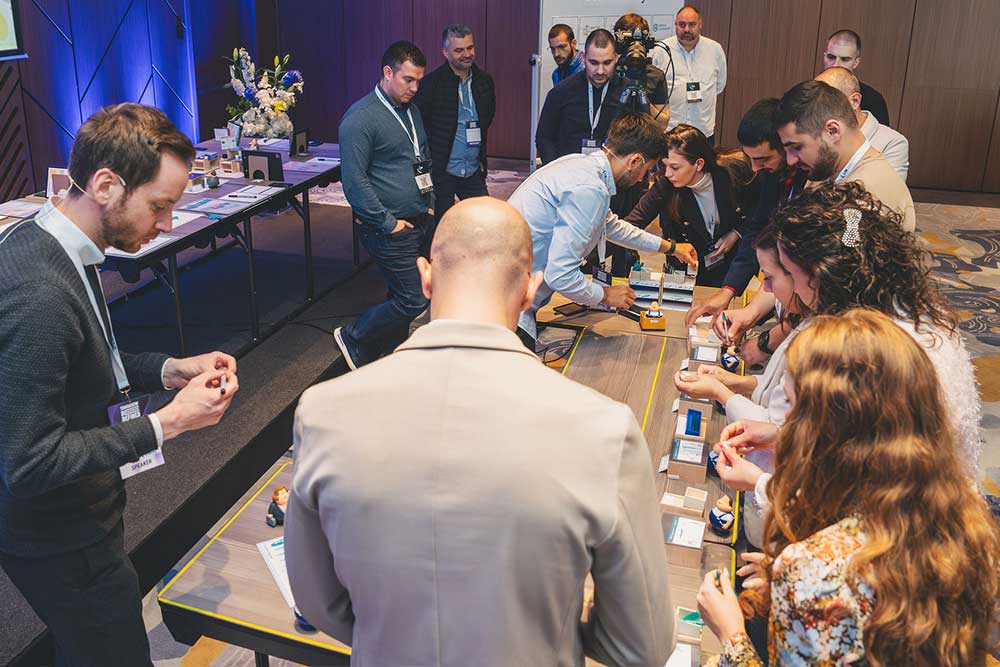
The physical Lean factory on the table: figures, parts and stations for workshops in the training room.
See the Factory Game
The Online Game demo runs in the browser, no installation.
FAQ
The 8 wastes: common questions.
What are the 8 wastes of Lean?
The 8 wastes of Lean are transport, inventory, motion, waiting, overproduction, overprocessing, defects and unused skills, often remembered as TIMWOODS. They use time, effort or material but add no value for the customer.
What does TIMWOODS stand for?
TIMWOODS stands for Transport, Inventory, Motion, Waiting, Overproduction, Overprocessing, Defects and Skills (unused talent). It is a memory aid for the eight wastes of Lean. DOWNTIME is another common acronym for the same eight.
What are the 7 wastes of Lean?
The seven wastes are Taiichi Ohno’s categories from the Toyota Production System: overproduction, waiting, transport (conveyance), overprocessing, inventory, motion and defects (correction). They are often remembered as TIMWOOD. The eighth waste, unused talent, is not one of Ohno’s seven; it was added as Lean spread beyond the factory.
What is muda in Lean?
Muda is the Japanese word for waste. In Lean it means any activity that consumes resources without creating value for the customer. Lean names it together with mura (unevenness) and muri (overburden), which often cause it.
Which of the 8 wastes is the worst?
Taiichi Ohno considered overproduction the worst, because it generates and hides other wastes such as inventory, defects and extra transport. In practice, start with the waste you see most often on a waste walk.
What are non-value-added activities?
Non-value-added activities use time or resources but do not change the product in a way the customer would pay for, such as waiting, searching or rework. Some are necessary today, like a legally required test, and should be kept small; the rest is pure waste.
What are examples of waste in manufacturing?
A forklift taking parts to a central store and back (transport), full pallets between stations (inventory), operators walking to a shared tool cabinet (motion), a station waiting for a slower one (waiting) and parts reworked after the final test (defects).
How do you identify waste in a process?
Go to where the work happens and watch, with the eight wastes as a checklist: a waste walk of 30 to 45 minutes is enough. Follow the product, follow one person and ask the team what slows them down. Count what you see per waste and start with the most frequent one.